
Reviewed · TOKYO CYCLING TOURS
Tokyo downtown bicycle tour Tokyo Backstreets Bike Tour
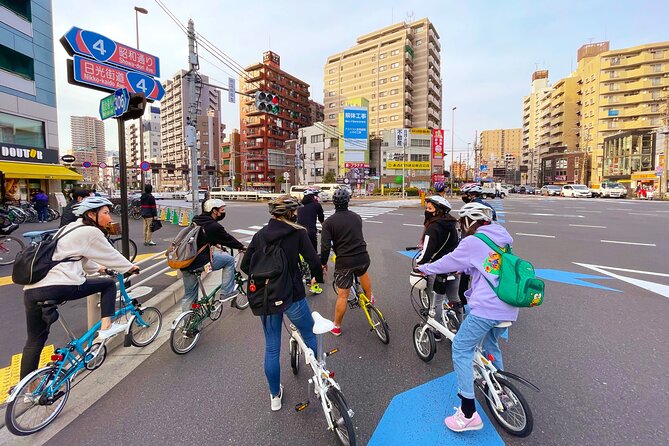
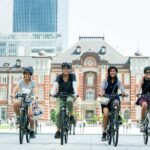
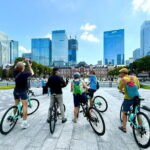
Tokyo reveals itself differently from a bicycle. On this four-hour ride, you move beyond the big avenues and cover about 15 kilometers through Asakusa, Sumida, and old neighborhood streets. The route links famous sights with small temples, gardens, craft displays, and shopping streets where daily life continues at a calm pace.
I like the small maximum group of six, which gives guide Takeshi Akiyama room to adjust the ride and answer questions. I also like the thoughtful extras: a bottle of water and a sakuramochi sweet from a traditional shop. The main consideration is the folding-bike size. Bikes suit people roughly 140 to 180 centimeters tall, so taller riders should contact the operator ahead of time.
In This Review
- Key points at a glance
- Why a bicycle works so well in eastern Tokyo
- Yamamotoya and the first taste of sakuramochi
- Honryuin Matsuchiyama Shoden and Imado Shrine
- Traditional crafts in the old downtown
- Senso-ji, with bicycles parked outside
- Kyu Yasuda Garden and Ryogoku Kokugikan
- Waterways, Skytree, and Kyojima
- What the guide adds
- Bikes, safety, and physical effort
- Is the $65.41 price fair?
- Who should book this ride?
- Should you book Tokyo Backstreets Bike Tour?
- FAQ
- How long is the Tokyo Backstreets Bike Tour?
- How many people can join the tour?
- Where does the tour start and finish?
- Are bicycles and helmets provided?
- What size riders can use the bicycles?
- Can children join the tour?
- Is food included?
- What happens if the weather is bad?
Key points at a glance
- A 15-kilometer route in about four hours: You see far more ground than on foot without spending the whole day in the saddle.
- Quiet Tokyo neighborhoods: The ride favors backstreets, local shopping areas, waterways, and residential streets over major tourist corridors.
- A traditional sweet stop: Yamamotoya serves sakuramochi, a salt-pickled cherry leaf wrapped around rice cake and red bean paste.
- A flexible guide-led outing: Takeshi can adjust the route to suit your interests and pace.
- Family options: Children as young as nine have taken part, and a tandem bike may be available with three days’ notice.
- A useful mix of famous and lesser-known sights: You pass Senso-ji and Tokyo Skytree, then spend time in places many visitors skip.
Why a bicycle works so well in eastern Tokyo
Tokyo is immense, yet many of its most interesting areas sit close together. A train can move you quickly between districts, but it skips the small connections between them. Walking gives you those connections, but covering Asakusa, Ryogoku, Kyojima, and the Skytree area in one morning or afternoon would be tiring.
This ride fills that gap. You pedal through streets with relatively light traffic, stop often, and get a guide’s explanation at each place. You are not simply checking off monuments. You are seeing how temples, shops, gardens, waterways, and ordinary homes fit together.
The pace is described as relaxed rather than athletic. That matters for families, older riders, and anyone still adjusting to Tokyo time. You get exercise, but the day is built around short stops and easy riding, not speed.
The ride starts at the Tokyo Backstreets Bike Tour office in Higashimukojima, in Sumida City, and returns there. The starting location can feel a little hard to identify at first, so allow extra time and watch for the shared office called Synapse. Once you meet the guide, the outing becomes much simpler.
A few more Tokyo tours and experiences worth a look
Yamamotoya and the first taste of sakuramochi
The first stop is Yamamotoya, known for Chomeiji sakuramochi. This traditional sweet consists of a rice cake filled with red bean paste and wrapped in a salted cherry leaf.
The leaf gives the sweet its distinctive salty, lightly floral note. You can eat it as part of the tour, or at least use the stop to learn why this local confection matters. It is a small introduction to Japanese food culture, and a more memorable start than being handed a generic snack.
The stop lasts about 10 minutes, with no separate admission charge. If you are not fond of red bean paste, this may not become your favorite food in Japan. Still, it is worth trying because the cherry leaf makes it different from the usual sweets found at department-store food halls.
Water is also provided. That is a modest detail, but useful on a warm afternoon, especially since parts of the route are outdoors with limited shade.
Honryuin Matsuchiyama Shoden and Imado Shrine
At Honryuin Matsuchiyama Shoden, you pause at a temple associated with Senso-ji and founded in 595. The temple is known for repeated images of daikon radishes and pouches.
The radish represents a mind caught in ignorance, while the pouch refers to benefits and good fortune. This kind of symbolism can be easy to miss when sightseeing alone. Takeshi’s explanations help turn an unusual decoration into a window on Buddhist ideas.
The stop takes about 20 minutes. It is not a grand, sprawling temple complex, so the appeal lies in the details and the story. You should not expect the same visual scale as Senso-ji.
Next comes Imado Shrine, founded in 1063. It is associated with relationships, marriage, and the beckoning cat, or maneki-neko. The shrine’s cat figures connect it with one of Japan’s best-known lucky symbols.
You get about 15 minutes here. It is a short visit, but a good contrast with the Buddhist temple. The route gives you different kinds of sacred places rather than treating every stop as another version of the same thing.
Traditional crafts in the old downtown
The Edo Taito Traditional Crafts Center presents Japanese handicrafts and the work of local makers. The stop lasts around 20 minutes and does not require an admission ticket.
This is one of the more useful pauses for anyone curious about Japan beyond its temples and electronics. You can see the care involved in traditional making and get a sense of the skills preserved in Tokyo’s older districts.
The center may be less exciting for young children than the shrine or the bicycle ride itself. For adults, it adds needed context. Tokyo is not only a city of new towers and neon signs. Its old downtown districts still support craft traditions, small workshops, and specialized shops.
The exact amount of time you spend here can depend on the group and your interests. The tour is flexible, so you can ask Takeshi for more attention to crafts, local life, food, or architecture.
Senso-ji, with bicycles parked outside
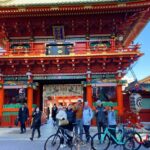
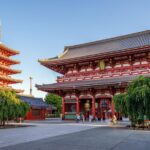
The route then reaches Senso-ji, Tokyo’s best-known temple in Asakusa. You cycle in front of the Kaminarimon gate, leave the bikes, and walk inside the temple area for about 20 minutes.
This is the most famous sight on the route, and it can be crowded. The bicycle does not make the crowds disappear, but it lets you approach Senso-ji as one part of a larger neighborhood ride rather than spending half a day there alone.
The brief visit is useful if you already plan to return to Asakusa. You can get oriented, see the major gate, and hear background from Takeshi before continuing. If Senso-ji is your top priority, tell the guide. The schedule can be adjusted, though a four-hour tour cannot provide unlimited time at every stop.
The mix is the point. You get the celebrated landmark, then move back into quieter streets instead of remaining in the busiest part of Asakusa.
A few more Tokyo tours and experiences worth a look

Kyu Yasuda Garden and Ryogoku Kokugikan
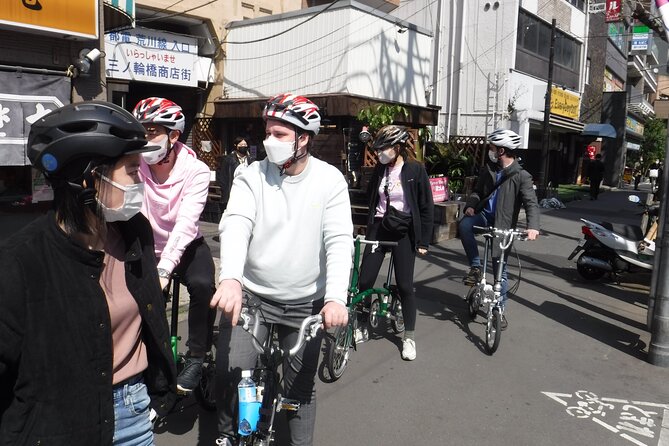
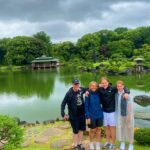
Kyu Yasuda Garden offers a calm change of pace. Built in the 17th century, the Japanese garden is visited on foot for about 20 minutes.
Gardens are especially welcome during a bicycle tour. You can stretch your legs, slow down, and look at the design rather than keeping your attention on traffic and directions. This is also a good place for photographs.
The garden visit is not a long guided garden tour. Think of it as a peaceful pause in the route. Its value comes from contrast: after temple streets and city riding, you get a carefully shaped traditional setting in the middle of modern Tokyo.
From there, you cycle by Ryogoku Kokugikan, the city’s sumo stadium. The stop lasts about five minutes and may allow time for photos.
Do not book this tour expecting a sumo match or a stadium visit. The venue is an outside sight on the route. Still, for first-time visitors, it is a worthwhile orientation point, especially if you want to understand where Tokyo’s sumo culture is centered.
Waterways, Skytree, and Kyojima
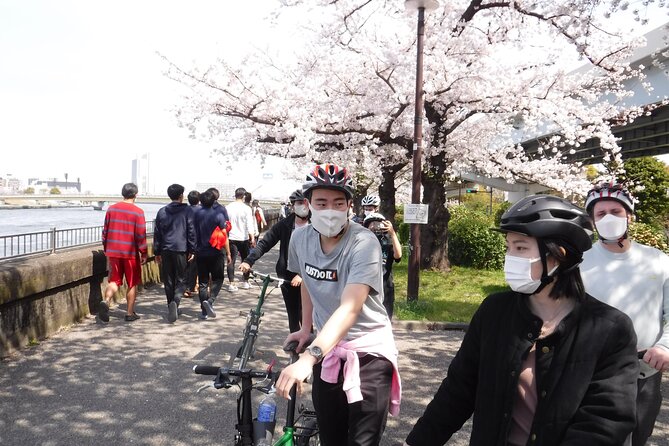
A longer 30-minute section follows Oyokogawa Water Park toward Tokyo Skytree. Riding beside a waterway gives you a different view of the city. You are moving through a corridor that feels less like central Tokyo’s major shopping districts and more like a local route between neighborhoods.
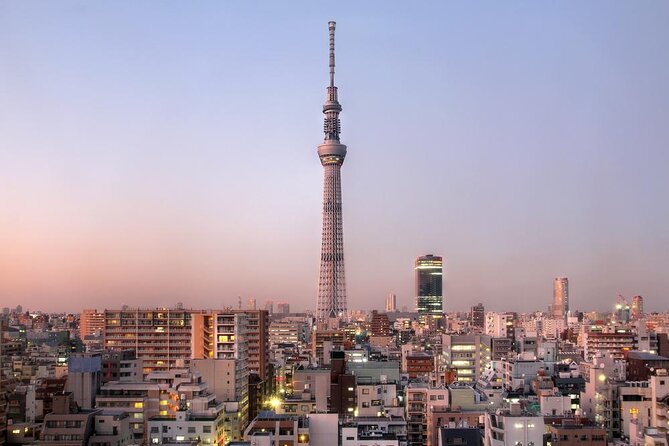
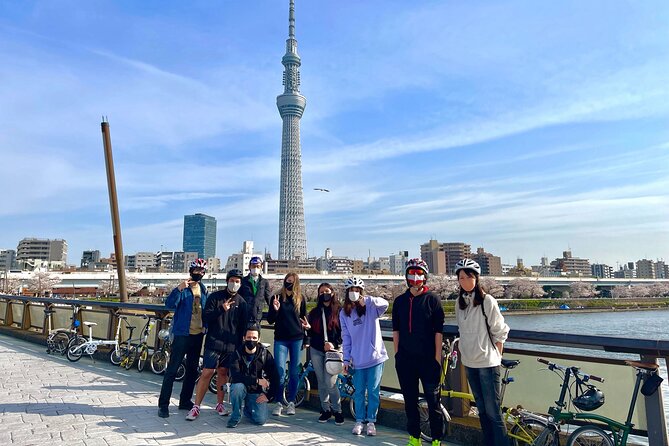
The Skytree stop lasts about 10 minutes, with the ride passing under the tower. This is a photo stop, not an ascent. Admission to the observation decks is not part of the experience.
That distinction is important. If you want panoramic views from the tower, you will need to arrange that separately. The bicycle tour is about seeing the structure in context and reaching areas around it that are easy to miss when you visit only by train.
The final major stop is Kyojima Minami Park, where you ride through old-fashioned shopping streets. This may be the most revealing part of the outing. Instead of a polished sightseeing zone, you get a glimpse of neighborhood commerce and everyday routines.
The stop is listed at about 30 minutes. Shops and activity can vary by day and time, so do not expect a staged cultural show. That is also why it feels useful. You are looking at a living neighborhood, not a reconstructed attraction.
What the guide adds
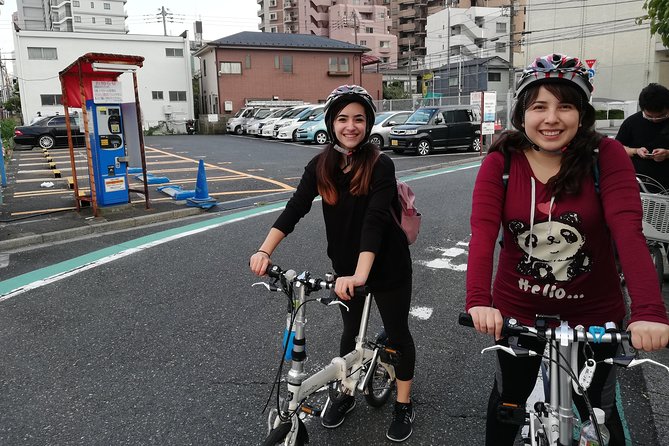
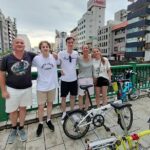
Takeshi Akiyama is central to the experience. The ride depends less on a dramatic performance than on steady guidance, local explanations, route decisions, and attention to the group.
He can customize the ride to suit your needs. Past outings have included extra attention to local food, crafts, neighborhood life, and places that were not originally the main focus. He also takes photographs during the ride, a welcome service when you want pictures of the whole group rather than another selfie.
The language provided is English. The guide’s friendly, patient approach is particularly helpful if you are nervous about cycling in a huge city. Several stops involve cultural details that are easy to overlook without explanation, such as the symbols at Matsuchiyama Shoden or the meaning attached to Imado Shrine’s beckoning cats.
The small group size makes a real difference. With no more than six people, it is easier to ask questions, stop for photographs, or mention that you would like to spend more time in one area. The tradeoff is that this is still a group tour, not automatically a private ride. If you want complete control of the route, confirm the arrangement when booking.
Bikes, safety, and physical effort
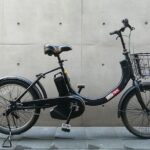
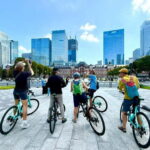
The supplied bicycles are folding bikes with 14 to 20 inch wheels. They are intended for riders between 140 and 180 centimeters tall. If you are taller than 180 centimeters, contact the operator before booking rather than hoping the fit will work on the day.
Helmets are provided, but they are not mandatory. I would wear one, especially if you are not used to cycling in Tokyo. The route is described as easy to follow, and many streets have relatively little traffic, but you are still riding in an urban area.
The tour covers about 15 kilometers in roughly four hours. That works out to a gentle pace because the group stops frequently. You should be comfortable riding a bicycle for several hours, getting on and off repeatedly, and walking around temples and gardens.
Families can take part. One family used a tandem bike for a nine-year-old, while children aged 12 and 14 rode their own bikes. A tandem must be requested at least three days before the tour date, so do not leave that request until arrival.
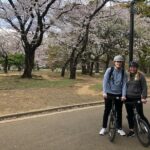
Weather is a serious factor. The ride requires good conditions and may be canceled for poor weather. One family had to cut its ride short because of rain, while another group found the summer heat noticeable. Spring blossoms and cooler months may be more comfortable, but the tour runs in different seasons, so check the forecast and dress accordingly.
Is the $65.41 price fair?
At $65.41 per person, this is not the cheapest way to get from one Tokyo sight to another. It is also more than renting a bicycle and following a map.
The value comes from what is included: roughly four hours of riding, a supplied bicycle and helmet, water, a traditional sweet, an English-speaking guide, and a route that connects ten stops. You also avoid spending time planning a safe path through unfamiliar streets.
For a first visit, the tour can act as a practical introduction to eastern Tokyo. You see Senso-ji and Skytree, but you also learn where local neighborhoods, gardens, craft centers, and old shopping streets sit in relation to one another.
I would consider it good value for couples, families, and repeat visitors who want something beyond the usual central Tokyo circuit. It is less compelling if you dislike bicycles, want extensive time inside each attraction, or prefer a private car and a fixed sightseeing schedule.
Group discounts may improve the price for larger bookings. Since the maximum group is six, ask about the discount when arranging a family or friend group.
Who should book this ride?
You should consider booking if you want to:
- See more than you could cover comfortably on foot.
- Visit Asakusa and the Skytree area while also seeing quieter neighborhoods.
- Learn about local symbols, crafts, sweets, and daily life.
- Get gentle exercise without signing up for a hard athletic ride.
- Have a flexible guide who can respond to your interests.
- Give children an active way to experience Tokyo.
You may want a different activity if you need a very large bicycle, want to ride at a fast pace, or hope to spend long periods inside museums and temples. The folding bikes are practical, but their stated size range matters.
Should you book Tokyo Backstreets Bike Tour?
I would book this ride early in a Tokyo visit, especially if you want a sense of the city’s older eastern districts. It gives you a useful map in your head: Asakusa’s temple quarter, Ryogoku’s sumo center, the Skytree area, waterways, gardens, and Kyojima’s local streets.
The strongest reason to choose it is the balance between famous sights and ordinary Tokyo. The cherry sweet, temple symbols, craft center, garden, and old shopping streets give the ride texture without requiring a full day.
Before booking, check your height against the bike range, request a tandem at least three days ahead if needed, and leave at least 24 hours for a cancellation if your plans change. If the weather looks poor, the operator offers another date or a full refund when the tour is canceled.
For a relaxed, small-group introduction to Tokyo’s backstreets, this is a smart use of half a day.
FAQ
How long is the Tokyo Backstreets Bike Tour?
The tour lasts approximately four hours. The route covers about 15 kilometers, including riding, sightseeing stops, and short walks.
How many people can join the tour?
The maximum group size is six travelers. The route can be adjusted to suit the group’s needs.
Where does the tour start and finish?
The tour starts at Tokyo Backstreets Bike Tour in Sumida City, at 2-chome 24-14 Higashimukojima, inside the shared office called Synapse. It finishes back at the same meeting point.
Are bicycles and helmets provided?
Yes. Folding bicycles and helmets are provided. Helmets are available but not mandatory.
What size riders can use the bicycles?
The folding bikes suit people approximately 140 to 180 centimeters tall. You should contact the operator in advance if you are over 180 centimeters.
Can children join the tour?
Most people can participate, and families have taken part. A tandem bike may be available, but you must request it at least three days before the tour.
Is food included?
Yes. Water and a snack from a traditional sweet shop are included. The route includes a stop for sakuramochi at Yamamotoya.
What happens if the weather is bad?
The experience requires good weather. If the operator cancels because of poor weather, you can choose another date or receive a full refund.
More Cycling Tours in Tokyo
More Backstreet & Hidden Rides in Tokyo
More Tokyo Cycling Tours in Tokyo
More tours in Tokyo we've reviewed



Tokyo Cycling Tours, compared.
 ★ 5.0Tokyo Great Cycling TourFrom $99
 ★ 5.0Tokyo Top Highlights 3h Guided E-bike TourFrom $63
 ★ 5.03h Tokyo E-Bike Tour: Hidden Gems, and Local Life with guideFrom $63
 ★ 4.83-Hour Bike or E-Bike City Highlights TourFrom $453 hours
 ★ 4.83-hour Guided E-Bike Tour of the City’s Hidden GemsFrom $65
 ★ 5.0Tokyo West-Side Cycling & Food TourFrom $99
 ★ 5.03-Hour Bike/E-Bike Tour of the City’s HighlightsFrom $63
 ★ 5.0Small Group Cycling Tour in TokyoFrom $66
Browse the lists this tour appears in