
The mistake people make on Kibi-no-michi is starting at Okayama Station. The bike-rental desk is hard to walk past, the platform exit feels like the obvious launchpad, and the next thing you know you’re four kilometres into urban traffic on a national-route footpath wondering why a cycling road needs this much warming up. The Momotaro Line runs from the same station to Bizen-Ichinomiya in fifteen minutes for ¥200, drops you outside a rental shop with a phone number you can ring an hour beforehand, and gets you onto the actual cycle path with the day still in front of you.
That’s it. Get the start right and the rest of Kibi-no-michi is a quiet seventeen kilometres of mostly flat cycle path between Bizen-Ichinomiya and Soja, threading rice paddies, two of Japan’s older shrines, the largest burial mound in the country you can actually walk on top of, and a five-storey Edo-period pagoda you’ll see from a kilometre out. It’s a half-day ride. It earns the day around it.

In This Article
- Kibi-no-michi at a glance
- How to get to the start
- Bringing your own bike
- Bike rentals: the named shops, what they cost, what you actually get
- Uedo Rent-a-Cycle (east end, Bizen-Ichinomiya)
- Araki Rent-a-Cycle (west end, Soja)
- Takatani Rent-a-Cycle (midpoint, Bitchu Kokubunji)
- The fleet and what each bike costs
- Cancellation and reservation
- Ushida Cycle (Bitchu Takamatsu Station)
- Picking up at Okayama Station instead
- What to expect on the trail itself
- Kibitsuhiko Shrine
- Kibitsu Shrine: a National Treasure two kilometres on
- The Momotaro story, briefly, because you’re cycling through it
- Tsukuriyama Kofun and the burial-mound cluster
- Bitchu Kokubunji and the five-storey pagoda
- Detours: Tsuru-no-Sato and Bitchu Takamatsu Castle
- Kinojo: the longer day-trip from Soja
- Where to eat along the way
- Kibi-dango
- Soja’s “bread town” lunch stops
- Okayama-bara-sushi and mamakari-sushi
- Best season for the ride
- Where to stay
- Practical answers
- Pair Kibi-no-michi with another route
Kibi-no-michi at a glance
Kibi-no-michi (sometimes written Kibiji from the same kanji 吉備路) is a designated cycling road through what was once Kibi province, the inland-sea trading power that ran western Honshu in the Yayoi and Kofun periods. The route is officially Okayama Prefectural Cycling Road; the formal trail runs about twenty-one kilometres if you start at Okayama Sports Park and finish at Soja Sports Centre. The version most cyclists actually ride is the seventeen-to-eighteen-kilometre stretch between Bizen-Ichinomiya Station in the east and Soja Station in the west, which is where the named landmarks and the rental shops are.
| Detail | Specifics |
|---|---|
| Distance | 17–18 km point-to-point (Bizen-Ichinomiya to Soja) |
| Riding time | 2–3 hours pedalling, 5–7 hours with stops |
| Elevation | About 26 m total. Effectively flat. |
| Direction | East to west (Bizen-Ichinomiya → Soja). Better signposted this way. |
| Surface | Sealed cycle path, rural lane, irrigation-canal towpath |
| Traffic | Light. One short shared section near Okayama JCT. |
| Best season | Late March to mid April (sakura), mid October to early November (rice harvest, cosmos) |
| Cost (rental + train) | ¥1,500 standard bike + ¥500 drop-off + ¥420 train back ≈ ¥2,420 |
This is not the Shimanami Kaido. There are no bridges to pay for, no ferry timetables, no two-day plans. It’s the cycling-day version of a Kyoto temple circuit: a short, flat ride that you build a longer day around by stopping at the temples, climbing a tomb, and queueing for fresh kibi-dango. The history is dense enough that researchers come back to it. The riding is gentle enough that grandparents bring grandchildren.
How to get to the start
.jpg)
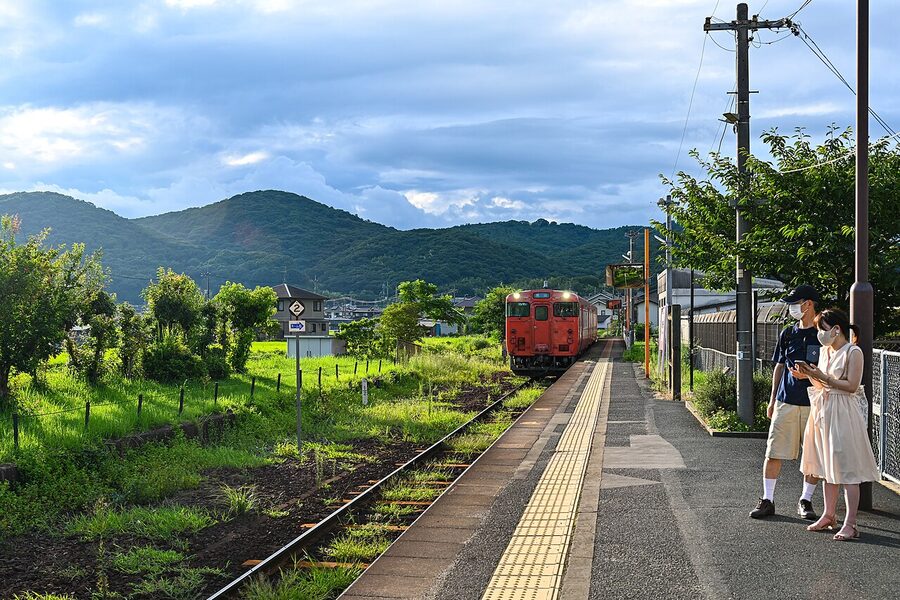
From Okayama Station, take the JR Kibi Line two stops to Bizen-Ichinomiya. Every sign and ticket calls it the Momotaro Line (桃太郎線), which is the marketing name JR West stamped on it in 2010 to lean into the local Momotaro folklore. Same trains. Same platforms. Two stops, fifteen minutes, ¥200, runs roughly every thirty minutes during daylight hours from Platforms 7 or 8.
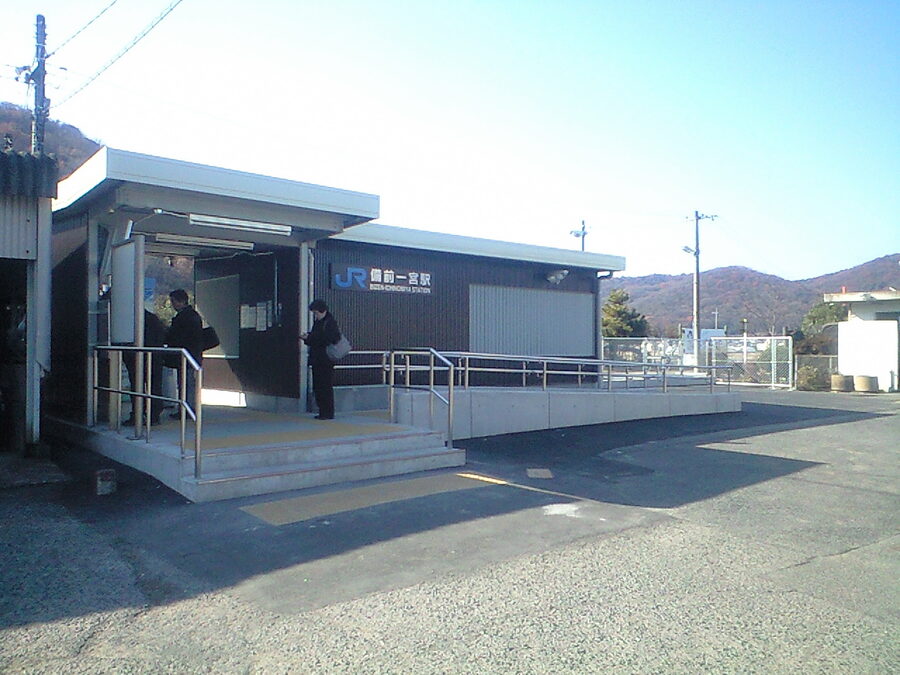
Bizen-Ichinomiya is a single-platform unstaffed local stop, which is a good sign rather than a bad one. The Uedo rental shop is across the level crossing, ninety seconds on foot. The trail begins at the back of the station car park.
The reverse leg back to Okayama at the end of the day, from Soja, has two options. The JR Hakubi Line goes via Kurashiki, takes about thirty minutes and costs ¥420. The JR Kibi Line goes direct in about forty-five minutes for the same fare. The Hakubi Line gets you to dinner faster. The Kibi Line is the more pleasant ride if you’re not in a hurry.
Bringing your own bike
JR allows folded bikes packed in a regulation cycling cover (rinko-bukuro) on every train including shinkansen, free of charge. The practical workflow is: arrive at Okayama, change to the Kibi Line, unpack on the platform at Bizen-Ichinomiya, ride. The Uedo staff are used to this and will hold your packing bag for the day for a small fee.
Bike rentals: the named shops, what they cost, what you actually get
Three rental shops on the route share an inter-shop one-way drop-off agreement. They run identical hours, identical prices, and the same booking line. A fourth shop near Bitchu Takamatsu Station is independent and worth knowing about for a different itinerary.

Uedo Rent-a-Cycle (east end, Bizen-Ichinomiya)
The classic east-end shop. Address Okayama-shi Kita-ku Ichinomiya 554, directly across the level crossing from JR Bizen-Ichinomiya Station. Phone 086-284-2311. Hours 09:00–17:00; the last rental goes out at 15:30. Closed Year-end / New-Year (officially 28 December to 5 January). Rural Japan, so confirm closure dates by phone if you’re riding in the first or last week of the year.
Araki Rent-a-Cycle (west end, Soja)
The mirror at the western end. Address Soja-shi Ekimae 2-1-5, directly outside JR Soja Station’s east exit. Phone 0866-92-0233. Same hours and prices as Uedo. Same Year-end closure window. The shop has its own booking website at kibiji-rent-a-bicycle-araki.jimdosite.com with an English-language link from the home page, which is worth knowing about because it’s the one shop on the route that takes online reservations directly.
Takatani Rent-a-Cycle (midpoint, Bitchu Kokubunji)
The midpoint option, north side of Bitchu Kokubunji. Address Soja-shi Yado 368-1. Phone 0866-93-3421. Hours and prices identical to the other two. Useful mainly if you’ve taken a taxi or driven to Kokubunji and want to ride the route as two short out-and-back legs rather than a point-to-point.
The fleet and what each bike costs
| Bike type | Per-day rate | Notes |
|---|---|---|
| City bike (16–27 inch wheel) | ¥1,500 (under 12yo: ¥500) | Step-through frame, basket, three speeds. Standard rental. |
| Sport bike (700c) | ¥2,200 | Drop bar, derailleur gears. Reservation required. |
| E-bike (26 inch) | ¥2,800 | Pedal-assist hub motor, three power modes. Reservation required. |
| Tandem (26 inch) | ¥6,500 | The genuine novelty. Two saddles, one chain. |
| Kibichari (吉備チャリ) special | ¥500 surcharge | The branded red-and-white cruiser. Total fleet of 11 across all three shops, so reserve. |
Two add-ons are charged per ride. One-way drop-off at any of the three shops is ¥500. Child seats (front for ages 1–4 under 15kg, rear for ages 2–6 under 20kg) are also ¥500. Helmets and rain gear are free loaners; you don’t have to ask twice. The shops will hold your packing bag, your suitcase, or whatever else you don’t want on the bike for free.
The standard play is rent at Uedo, ride east-to-west, drop off at Araki, train back to Okayama. Total day cost on a city bike: ¥1,500 rental + ¥500 drop-off + ¥420 train back = ¥2,420 plus the ¥200 to get to the start. If you’re paying for an e-bike or sport bike, add the difference. There’s no time-of-day discount, no half-day rate, and no time-based rental at the three Kibichari shops. You pay the day price and you can use the bike from 09:00 to whenever you drop it back before 17:00.
Cancellation and reservation
Reservations are accepted up to three days before by email or phone. Cancel inside three days and you pay 20% (two days out), 50% (the day before), or 100% (same-day or no contact). Rain forecasts are an explicit get-out: phone before your reservation time and a weather cancellation costs nothing. For weekday standard rentals you can usually walk in. For sport bikes, e-bikes, tandems, weekend rentals, and any of the eleven Kibichari, phone the day before. The 11-bike Kibichari fleet is the genuine constraint.
Ushida Cycle (Bitchu Takamatsu Station)
The fourth and independent shop. Address Okayama Kita-ku Takamatsu Furusai 308, three minutes on foot from JR Bitchu Takamatsu Station. Phone 086-287-2167. Hours 09:00–18:00. Closed Wednesdays, the first and third Sundays of every month, and Year-end. Day rate (six hours or more) ¥880; two-hour rate ¥330. Three bikes total, no drop-off available, reservation required by the day before. The maths only works if you’re starting from Bitchu Takamatsu (perhaps because you’re combining the cycling with Bitchu Takamatsu Castle ruins) and returning the bike where you collected it.
Picking up at Okayama Station instead
The JR Eki Rinkun bike-share desk inside Okayama Station rents basic city bikes from ¥350 a day. It exists. The economics flatter the headline, but you’ll spend the savings cycling six urban kilometres out and another six back, and the bike isn’t drop-off-able at Soja. Worth it if you want a bike for general Okayama errands rather than for the Kibi-no-michi specifically.
What to expect on the trail itself
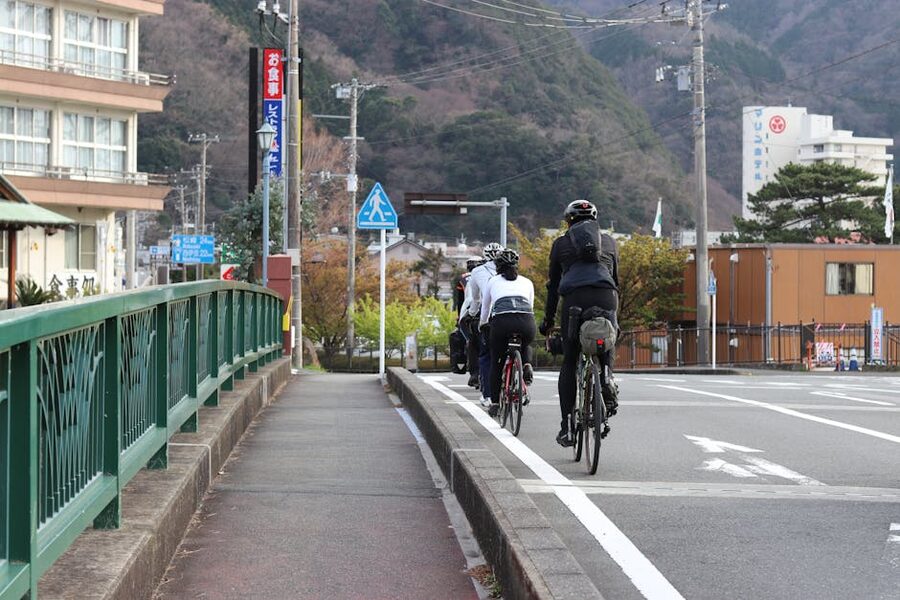
The route is mostly a separated cycle path painted blue along the edges, threading rice plain on the south side of Kibi-no-Nakayama (吉備の中山, the wooded hill between the two main shrines). Some stretches put you on a quiet rural lane shared with farm vehicles, and one short section near Okayama JCT pushes you onto a shoulder of a busier road for about four hundred metres. Surface is uniformly sealed except for two short gravel-towpath sections by the irrigation canals; a road bike on 25mm tyres handles all of it.
The signposting is bilingual on the main directional posts (the white-and-blue cycle-route markers) and Japanese-only on the temple-side information boards. Going east to west is the better-marked direction. Going west to east, the signs that ought to face you are placed for traffic going the other way and you’ll occasionally have to read the back of them.
One spot causes more confusion than the rest. About a kilometre west of Bizen-Ichinomiya, the cycle path runs along an irrigation canal with the green hump of Kibi-no-Nakayama on your left. At the first proper bridge across the canal, the marked route switches sides: you cross the bridge and pick the path back up on the south bank. The turn isn’t well marked. People miss it, find their way back via Google Maps, and lose ten minutes. If you know to expect the bank-swap at the first canal bridge, you’ll cross without a second thought.
Kibitsuhiko Shrine
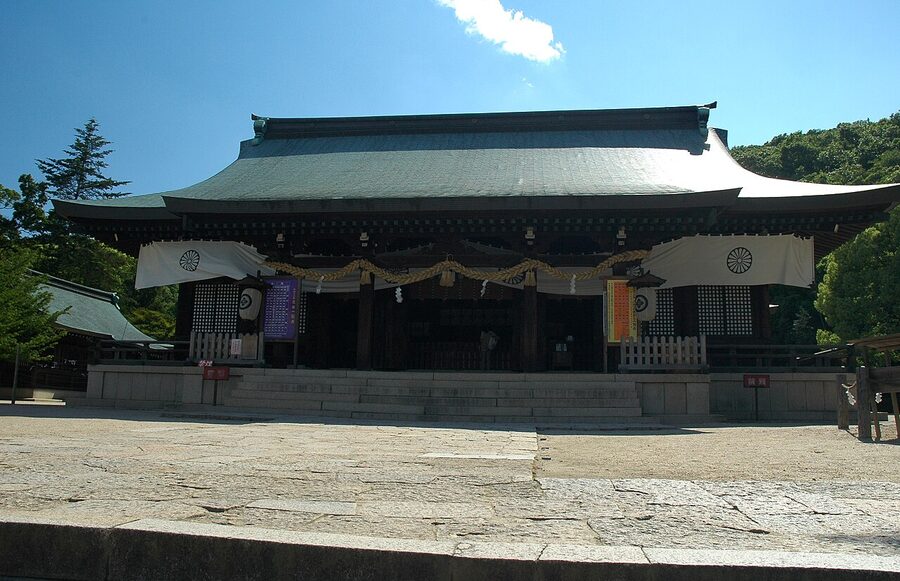

The eastern end of Kibi-no-michi is anchored by Kibitsuhiko Shrine (吉備津彦神社), one of the two founding shrines of old Kibi province. Five minutes by bike from the rental shop, north side of the trail. Grounds are open all daylight hours; admission free.
Kibitsuhiko was built on what’s traditionally said to be the residence of Kibitsuhiko-no-mikoto (吉備津彦命), the prince later mythologised into Momotaro. The two stone garden lanterns flanking the worship hall stand 11.5 metres tall on six stacked stone bases, late-Edo carving in local granite. They’re the largest of their kind in Japan. You’d ride past them in a minute if nobody had said to stop.

The detail most visitors miss: the komainu lion-dogs guarding the torii are made of Bizenyaki (備前焼), the unglazed brown earthenware Okayama Prefecture is famous for. Pottery komainu are unusual outside the immediate region. Their faces sit different from the standard stone version: they look you in the eye rather than over your shoulder. Most cycling visitors photograph the lanterns and walk past the komainu, which is a shame because the komainu are arguably the more interesting object.

Allow twenty to thirty minutes here. The bilingual information panels are above-average for a regional shrine; whoever wrote them clearly cares about the Momotaro story. There’s a small statue of Momotaro with the dog and the monkey in the parking lot if you want a souvenir photograph with the legend itself.
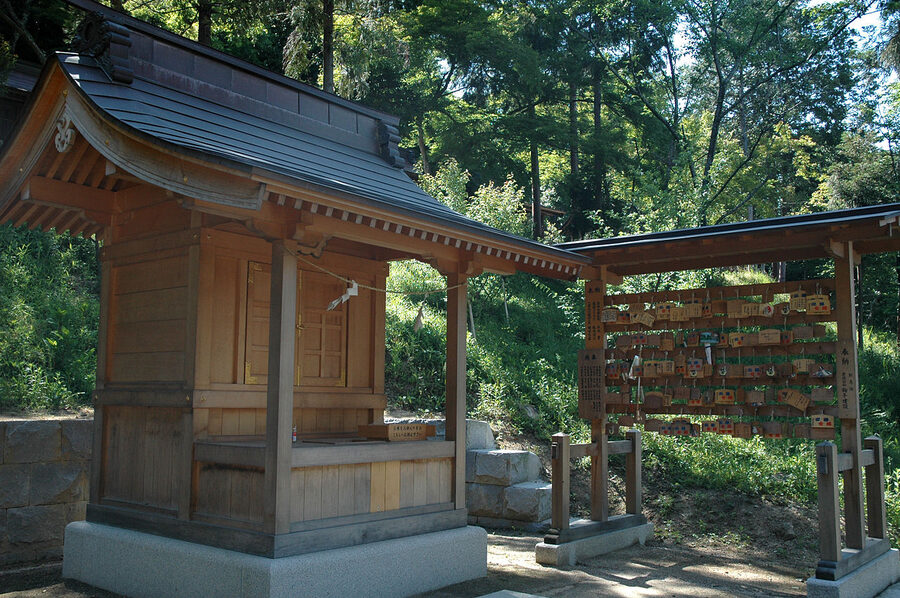

Kibitsu Shrine: a National Treasure two kilometres on
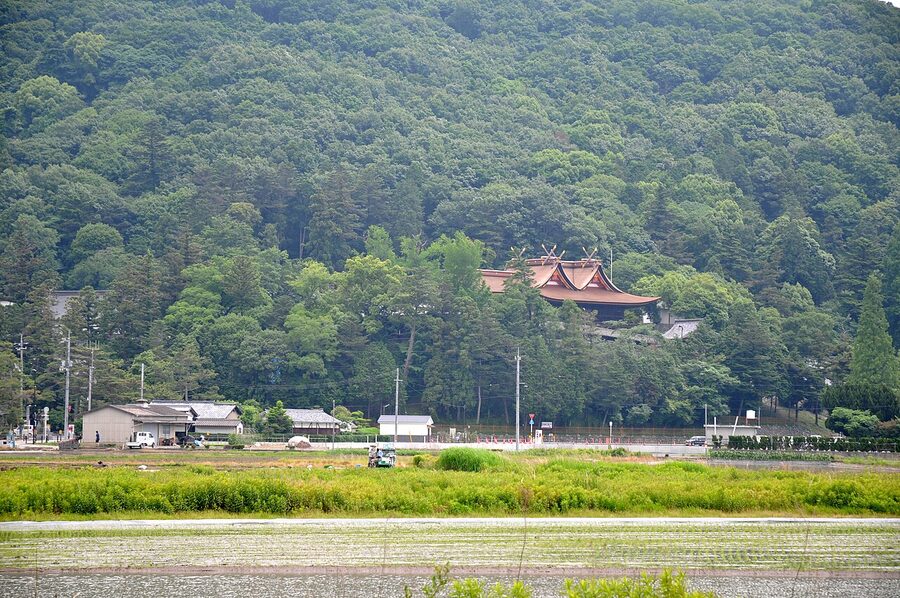

From Kibitsuhiko it’s two kilometres along Kibi-no-Nakayama-michi, the pine-lined lane that links the two shrines, to Kibitsu Shrine (吉備津神社). The names are similar enough that travellers conflate them. They’re separate shrines, both worth the stop.
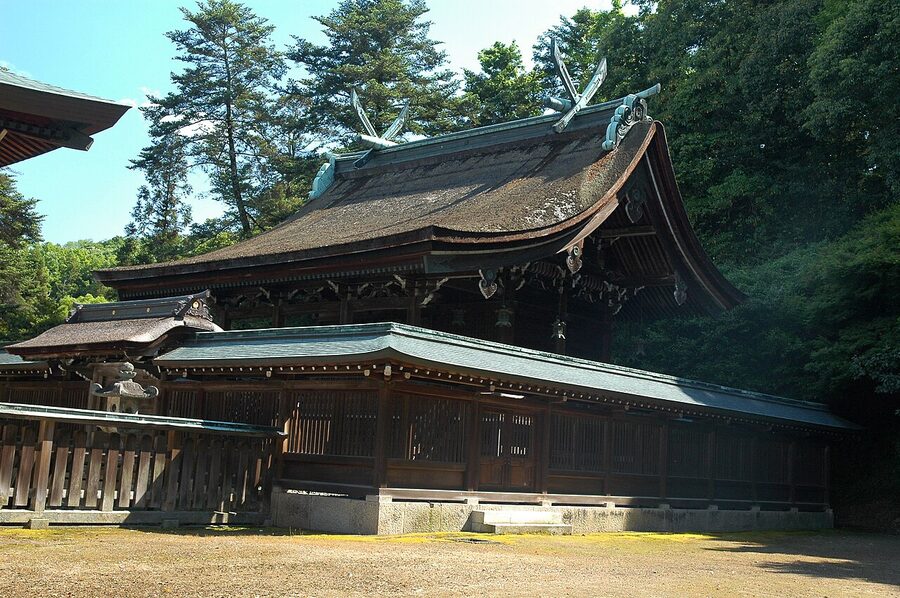
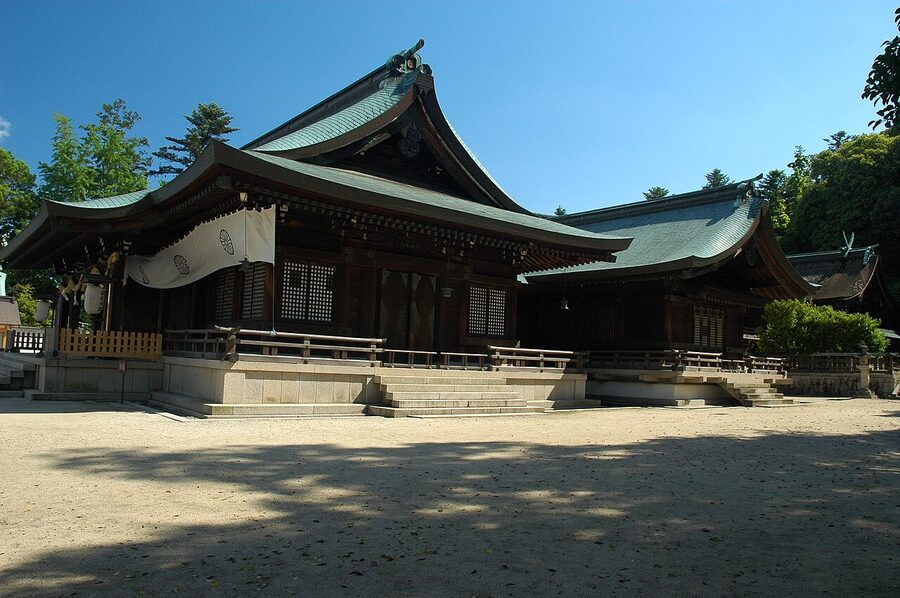
Kibitsu’s main hall and worship hall were rebuilt in 1425 in a style called Kibitsu-zukuri (吉備津造): twin staggered gables joined by a single ridge, the whole thing thatched in cypress bark. It’s the only surviving example anywhere in Japan. The hall has been a National Treasure since 1952. Almost nobody outside Japan has heard of it, which is part of why the ride feels like you’ve stumbled into a corner the guidebooks haven’t reached yet.
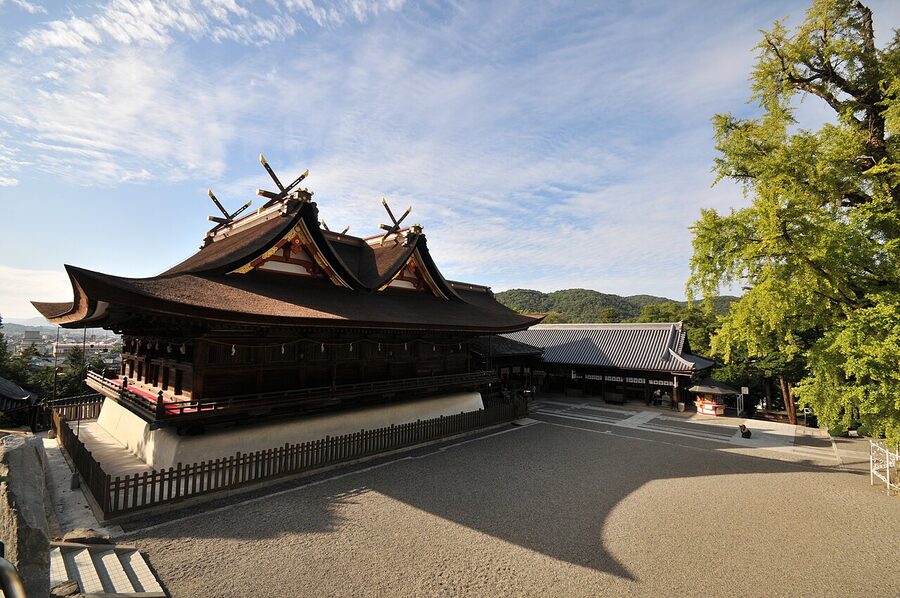

The single feature most worth your time is that long covered corridor. Three hundred and sixty metres in one straight diagonal from the worship hall down the slope, roofed in the same cypress bark as the main building. You walk it. You photograph it. It’s the kind of thing you didn’t know was a category of Japanese architecture until you’d seen one. There’s nothing else like it on the route.
Within the precinct is Okamaden (御釜殿), the ritual hall of the Narukama-shinji (鳴釜神事), a fortune-telling rite that’s been performed continuously at this site for centuries. A priest boils water in an iron cauldron; the cauldron groans, and the priests interpret the groan as the answer to a petitioner’s question. According to the local Momotaro variant, the cauldron sits on top of the buried head of Ura, the iron-smelting Korean prince that the Yamato court mythologised into a man-eating ogre. You can request a reading. It’s a real ritual, not a tourist re-enactment, and you give what you’re prepared to give rather than a fixed fee.
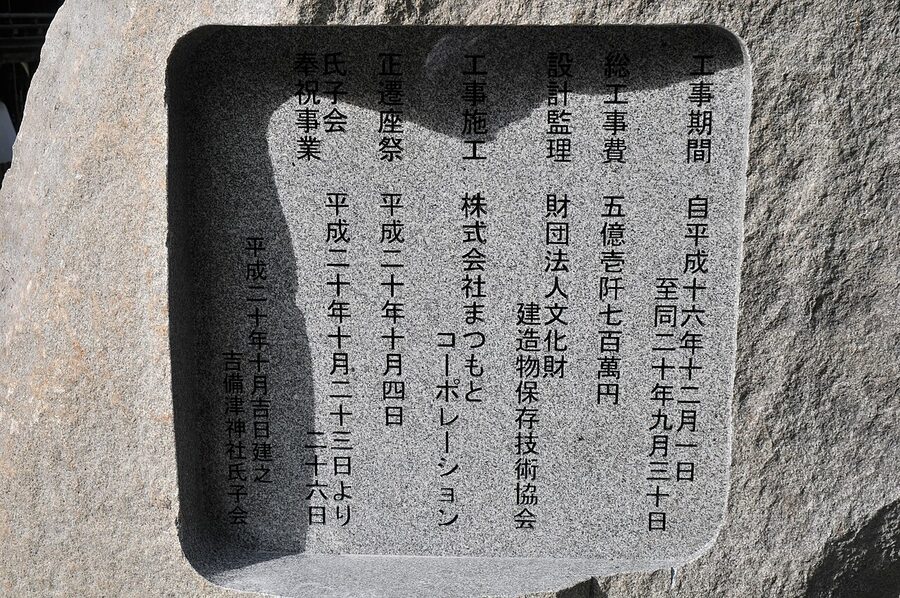

Grounds are open from roughly 05:30 to 18:00, free admission. Allow forty-five minutes. The treasure house holding wood-block prints and old palanquins is open 09:00–16:00 for an entry fee of ¥300; skippable on a first visit if your time is tight.
The Momotaro story, briefly, because you’re cycling through it
You don’t have to care about Momotaro folklore to enjoy the route. The shrines and the pagoda hold up on their own. But the legend is the thread the whole ride hangs on, and a five-minute summary makes the road signs and the place names start to mean something.
Most foreign visitors know the children’s-book version. A peach floats down a river, an old woman cuts it open, a boy pops out, the boy grows up, recruits a dog and a monkey and a pheasant by sharing kibi-dango millet dumplings, and goes off to defeat a band of ogres on a distant island. Toys, anime, manhole covers, JR Line nicknames, the lot.
The Kibi version of the story is older and a great deal bloodier. The “boy” was Prince Isaserihiko of the Yamato clan, an excellent archer who lived during the Yayoi period roughly two thousand years ago. He fought a man called Ura, an iron-smelting prince of Baekje (the south-western Korean kingdom of the time) who had set up a fortress in the mountains above Kibi. They shot arrows at each other; the arrows collided in midair at a place now marked by Yaguinomiya Shrine; eventually Isaserihiko shot Ura through the left eye. Ura turned into a pheasant and fled. Isaserihiko turned into a hawk and pursued him. Ura turned into a carp and dove into a river. Isaserihiko turned into a cormorant and ate him.
The conclusion: Ura’s severed head was buried at what’s now Kibitsu Shrine, where it groaned every night for years until the prince offered to let Ura’s wife light the fire under the cauldron. The groaning became fortune-telling. The cauldron became a ritual instrument. The prince became Kibitsuhiko-no-mikoto, “the noble of Kibitsu”, deified at the shrine that bears his name.
Whether Ura was really an exiled Korean prince and the “ogre” framing is propaganda from the winning side is exactly the kind of question Japanese amateur historians keep arguing about online. The archaeological record at Kinojo, the supposed ogre fortress, suggests the Korean-prince reading. So when you cycle past a torii or a stone marker named after some figure from the legend, you’re cycling past one side of an argument about who really lived here in the third century.
Tsukuriyama Kofun and the burial-mound cluster
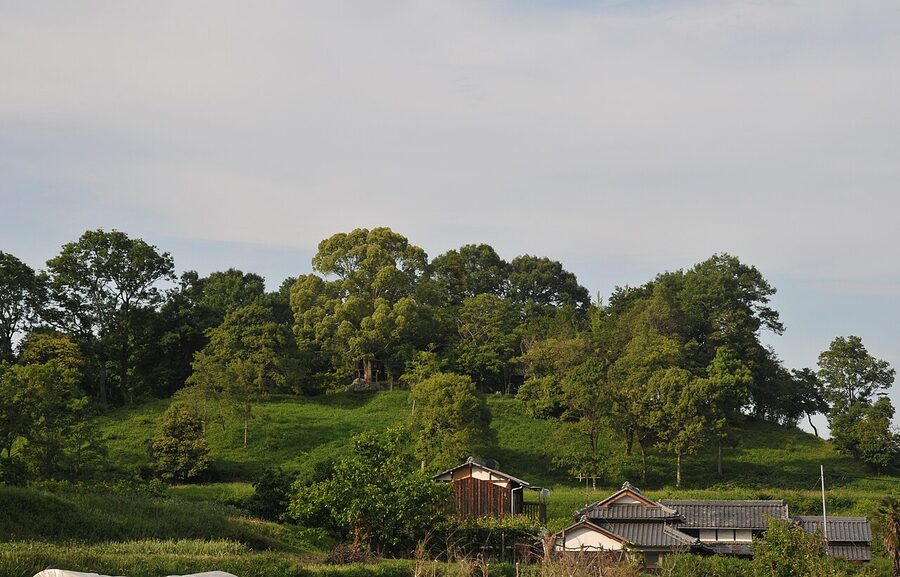

Roughly midway through the route, west of the canal-bridge bank-swap, the cycle path runs the length of an enormous green ridge that on first look reads as a hill. It isn’t. Tsukuriyama Kofun (造山古墳) is a man-made keyhole-shaped burial mound from the fifth century, 350 metres long, the fourth-largest in Japan. The first three are imperial tombs in Osaka and Nara managed by the Imperial Household Agency, which means visitors aren’t allowed onto them. Tsukuriyama is the largest tomb you can actually walk on top of.
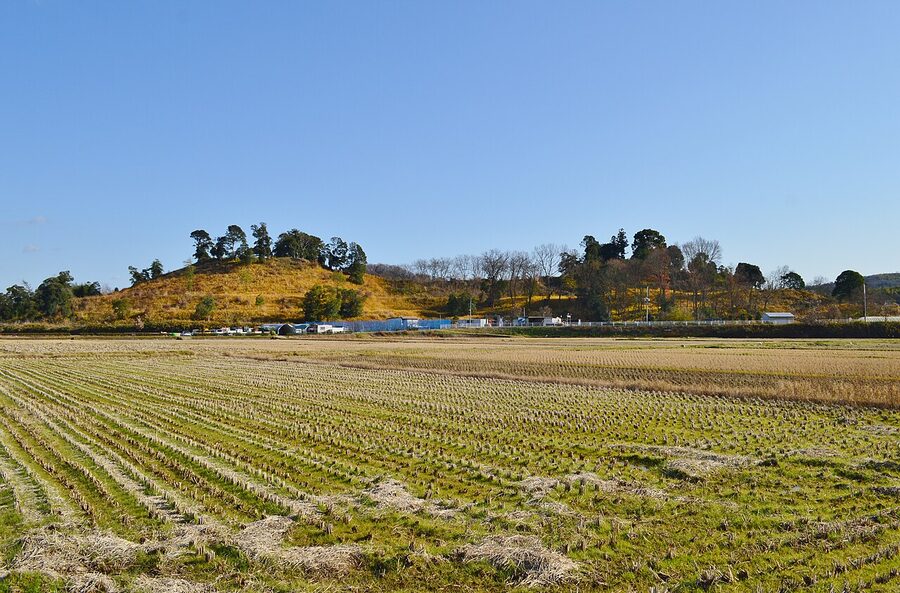
The visitor centre at the base is small, free, and worth a stop. It explains why Okayama, of all places, has two of Japan’s ten largest burial mounds. The short version: from roughly 300 to 500 AD, iron from the Korean peninsula entered Japan via the Seto Inland Sea trade route. Whoever controlled that route got rich enough to build large tombs. The Yamato court in Nara and the Kibi court here were the two big controllers, until the Kibi clan rebelled against Yamato in the late fifth century and lost. The mounds you’re cycling past are what’s left of the losing side’s wealth.
To climb Tsukuriyama, look for the small Kojin Shrine (荒神社) on the front-square section of the mound. That’s the marked entry point. The path is steep but stable. Allow twenty minutes for the round-trip on foot. Lock the bike at the visitor-centre rack rather than the mound itself; the path up isn’t bike-friendly.
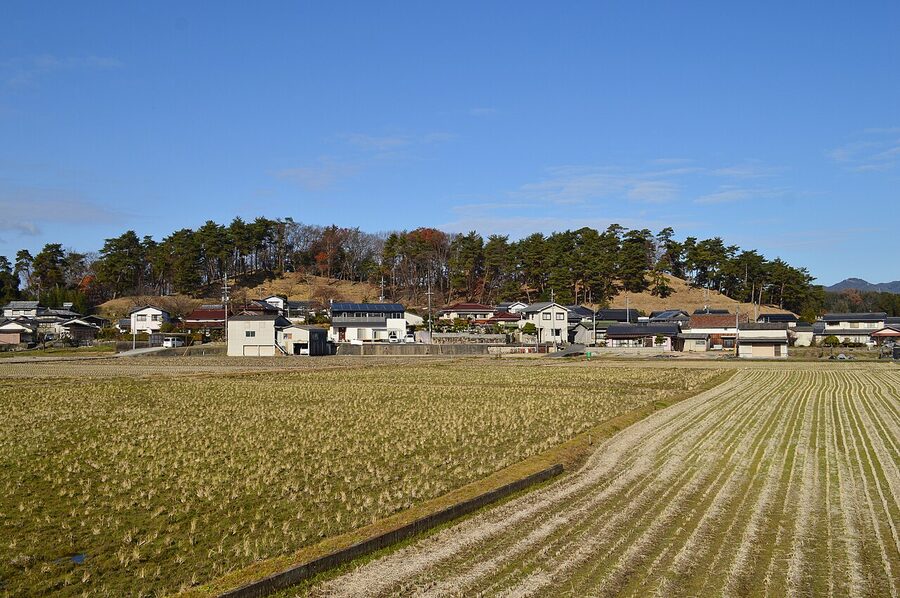
Two and a half kilometres further west, the route passes Sakuyama Kofun (作山古墳), the tenth-largest mound in Japan and the second-largest in Okayama Prefecture. Smaller than Tsukuriyama and less restored, but you can still climb it via a path on the front-square section. A jizo statue marks the start. Most cyclists do one mound rather than both, given the time budget. The vote goes to Tsukuriyama because of the visitor-centre context.
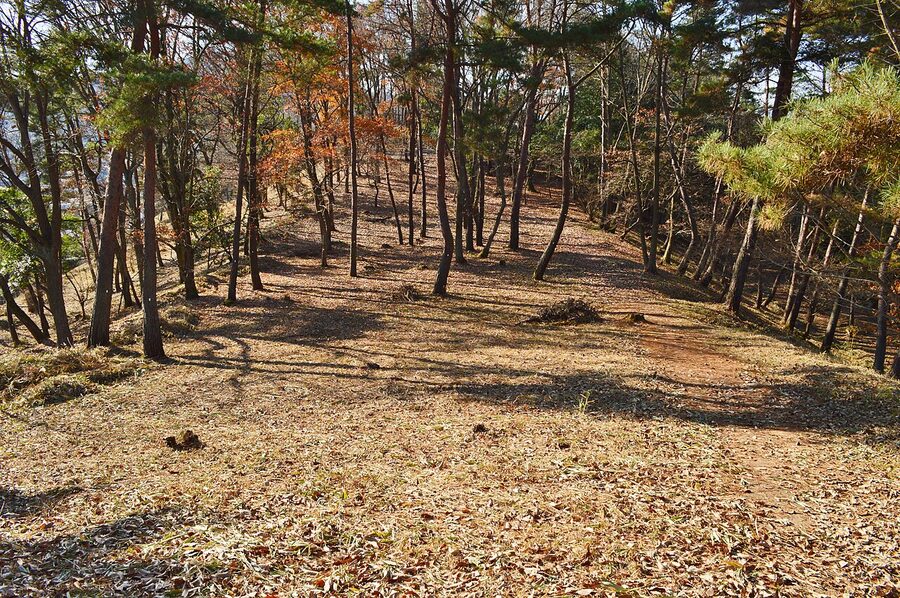
For the genuinely tomb-fascinated, there’s also Komorizuka Kofun (こうもり塚古墳) right next to Bitchu Kokubunji. Smaller (ninth-largest in the prefecture), but with a horizontal stone burial chamber you can actually walk into. That’s the unusual part: most kofun chambers are sealed, and the few you can enter are usually small. Komorizuka’s chamber is enormous and the family-style stone sarcophagus is still inside.
Bitchu Kokubunji and the five-storey pagoda
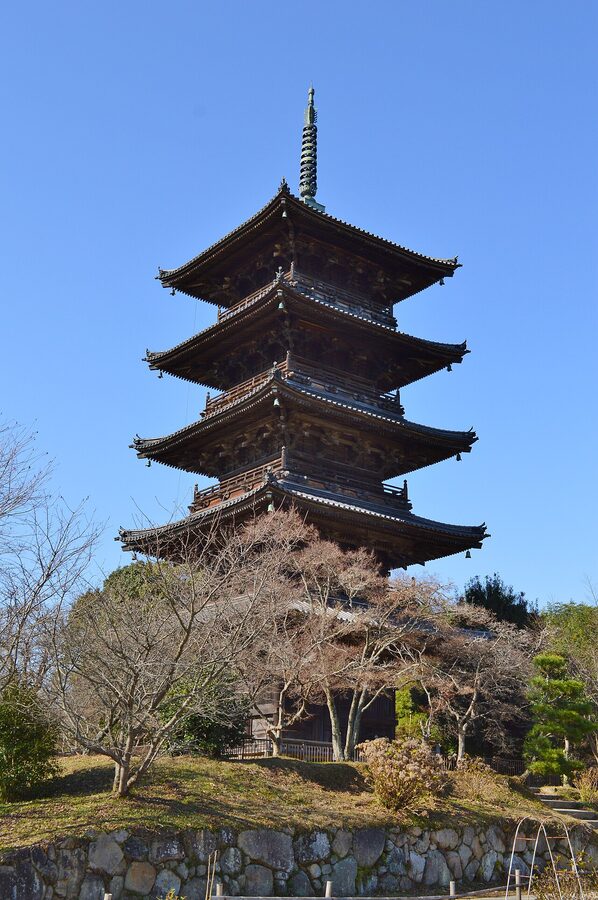
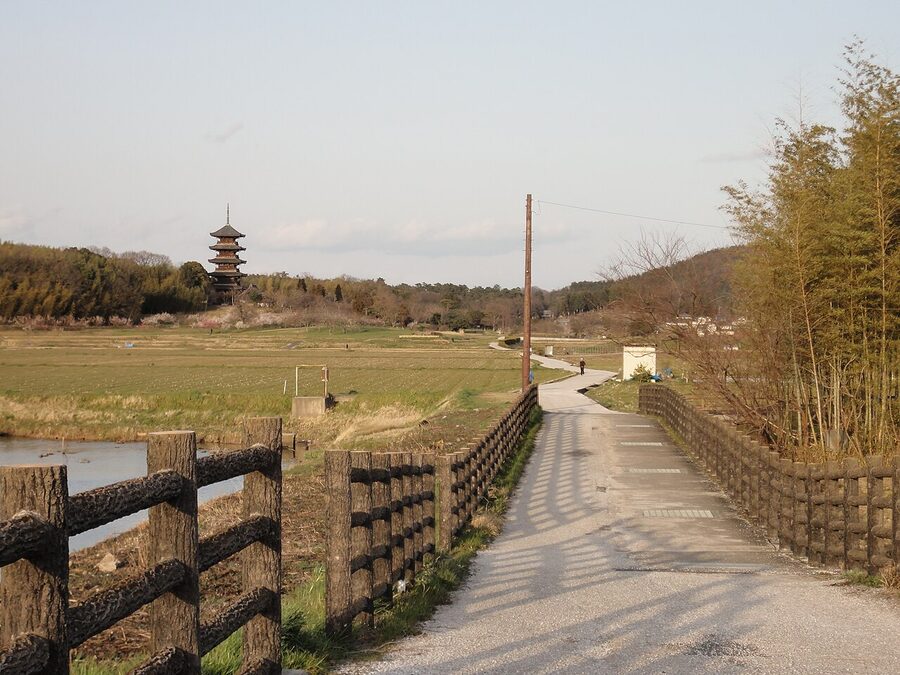
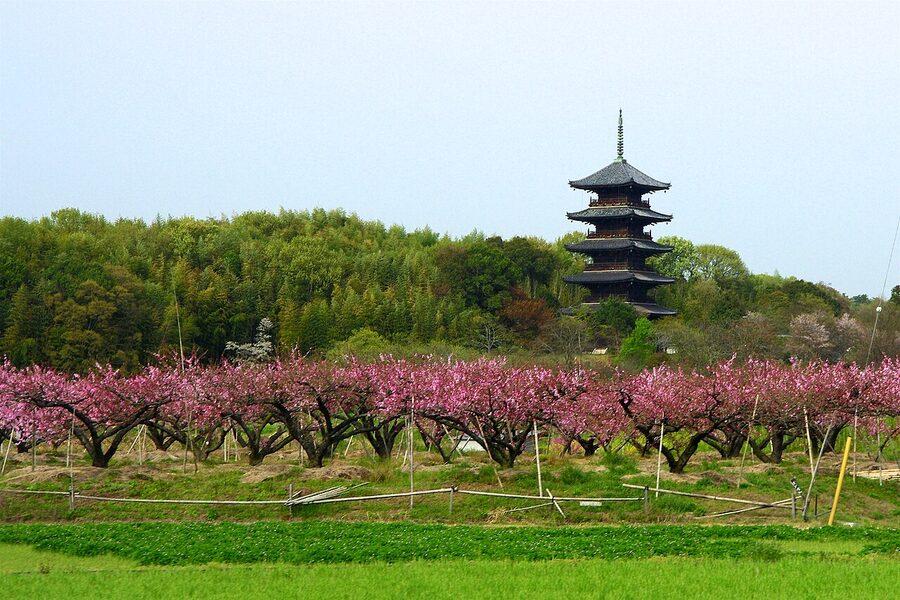
The structural anchor of the route, the photo every cyclist takes, the silhouette in every Japanese-language tour brochure, is the five-storey pagoda at Bitchu Kokubunji (備中国分寺). It’s Okayama Prefecture’s only five-tiered pagoda. You see it from at least a kilometre out. It rises about 34 metres, which sounds modest until it’s lining up dead-centre with the cycle path through the rice paddies.
Bitchu Kokubunji was originally founded in the Nara period (eighth century) by Emperor Shomu, one of a network of provincial Kokubunji built to protect the country from natural disasters. The original buildings were destroyed by fire during the Nanboku-cho period (fourteenth century). The pagoda you see today is the rebuild, completed in 1844: zelkova and pine, mid-Edo carpentry. The original was supposedly seventy metres tall; the rebuild ran out of money at half that height.
.jpg)
Grounds are open and unfenced. You can wander among the buildings, sit on a stone bench in front of the pagoda, and listen to the wind in the cypress around the foundation stones of the original Nara-period seven-storey pagoda. Free admission. There’s a small teahouse inside the precinct that sells matcha and a steamed sweet bun called kibi-midori-manju (吉備みどりまんじゅう), green from millet flour, baked on site. Take fifteen minutes. The teahouse is one of those operations the editorial sites mention in passing and the locals swear by.
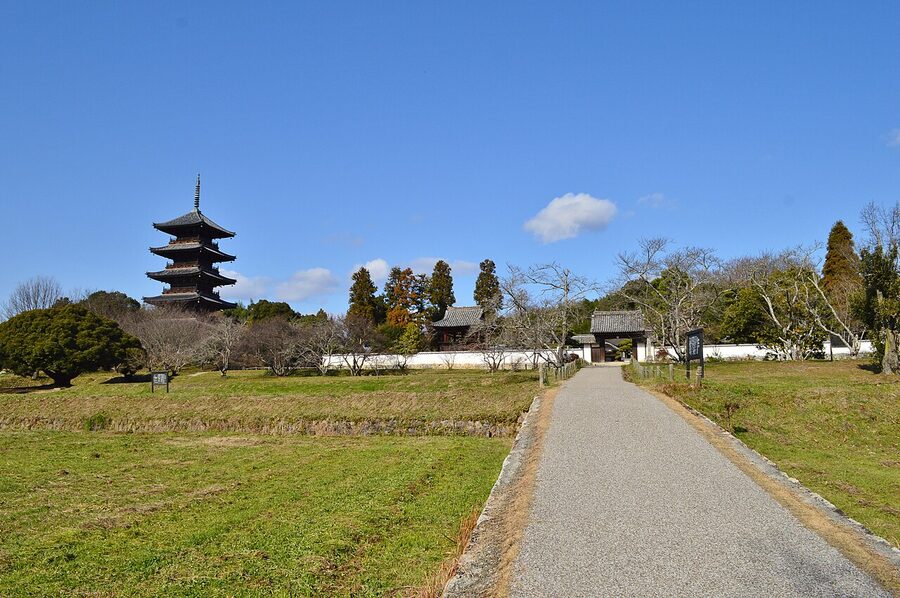
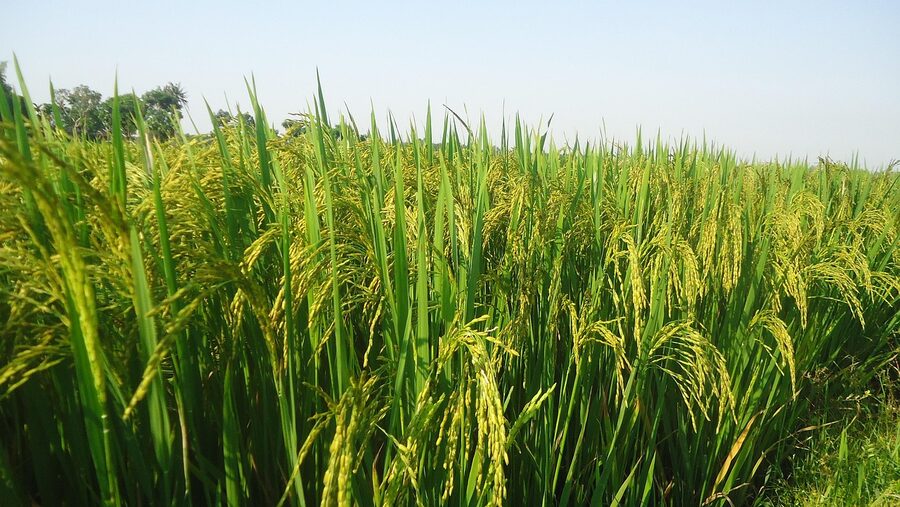
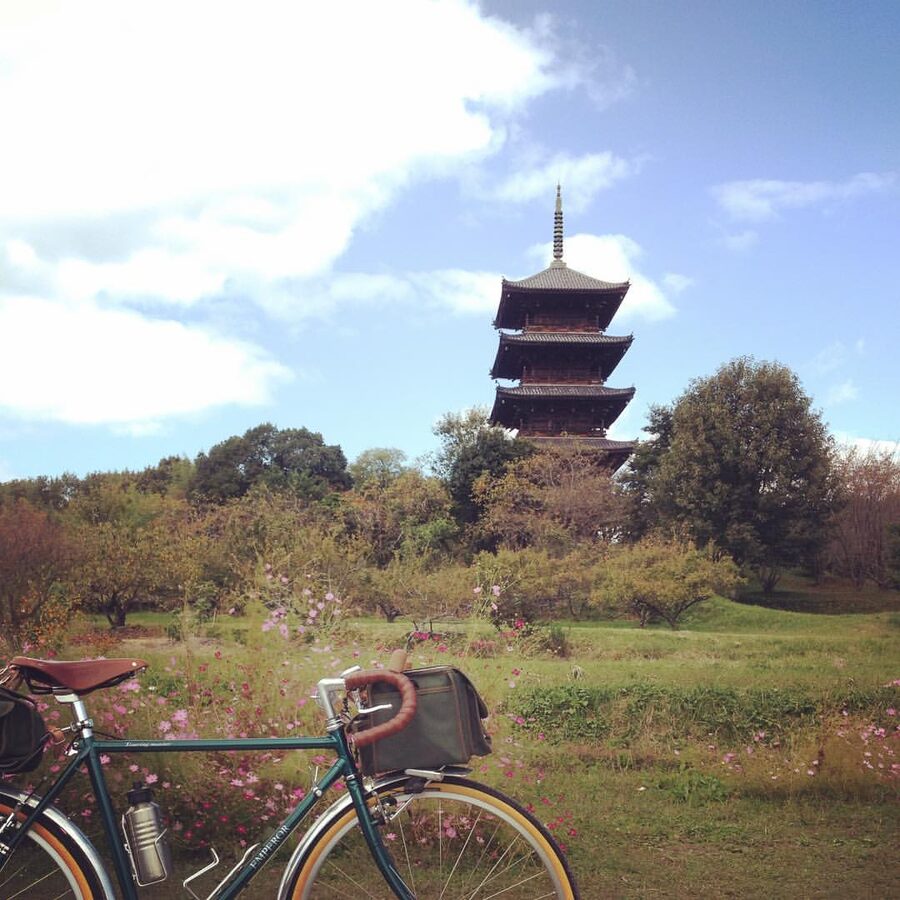
The seasonal angle matters here. The fields immediately around the pagoda are rotated by the local agricultural co-op specifically for the photographic effect: rape blossoms (yellow) in late winter, cosmos (pink) in early autumn, sunflowers in summer, ripe rice in October. If you’re picking a single date for the whole ride, mid-October hits the rice-and-cosmos peak. Late March hits the sakura. Either is the right call.

Detours: Tsuru-no-Sato and Bitchu Takamatsu Castle
Two side-trips are worth knowing about if your timing allows. Both add roughly thirty to forty minutes round-trip and require a route deviation rather than a direct extension of the trail.
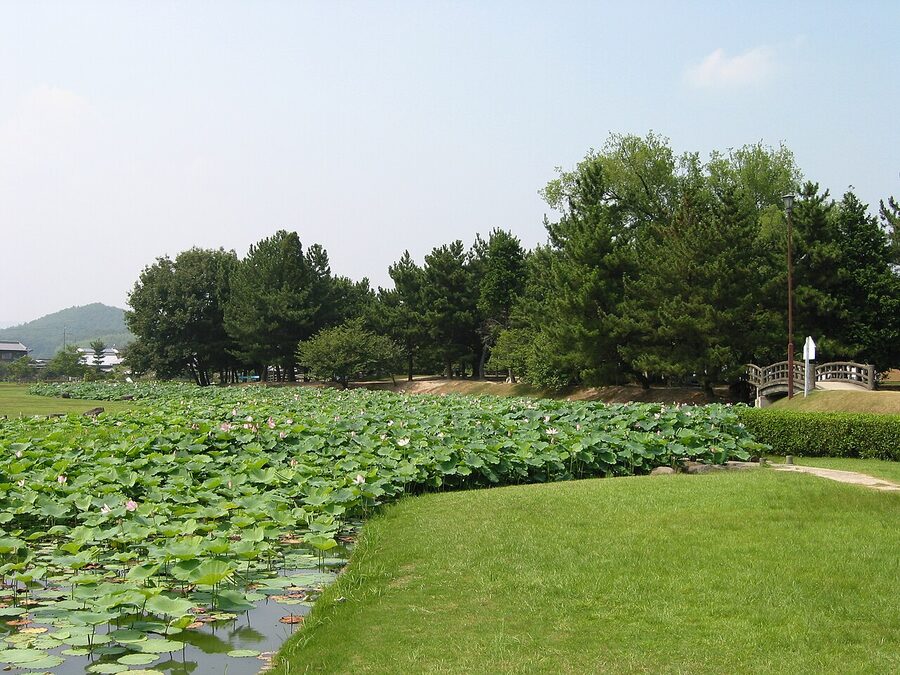
Tsuru-no-Sato (吉備路鶴の里), about two kilometres south of Bitchu Kokubunji, is a small breeding facility for Japanese red-crowned cranes (a Special Natural Treasure species). Free, mostly empty on weekdays, and the cranes laze on the lawn beside the water in a way that’s easier to photograph than it ought to be. There used to be a hotel attached called Sun Road Kibiji; per Okayama tourism listings it’s currently closed for refurbishment, so don’t plan an overnight here without phoning first.

The other detour is Bitchu Takamatsu Castle (備中高松城), about three kilometres north of the main trail near Okayama JCT. The castle itself is a green field today (nothing structural survives), but the site is famous for what happened in 1582. Toyotomi Hideyoshi was besieging it when news arrived that Oda Nobunaga had been betrayed and killed in Kyoto. Hideyoshi forced a quick surrender by diverting a river and flooding the castle, then made the legendary forced march back to central Japan to revenge Nobunaga. The free Castle Museum on site (Bitchu Takamatsu-jo Shiryokan, 09:00–16:00, closed Mondays) walks you through it. Forty-five minutes if you read the panels.
Take one detour if your timing allows, both if you’ve started early. Skip both if you want to be back in Okayama before sunset for dinner. The main route is full enough on its own.
Kinojo: the longer day-trip from Soja
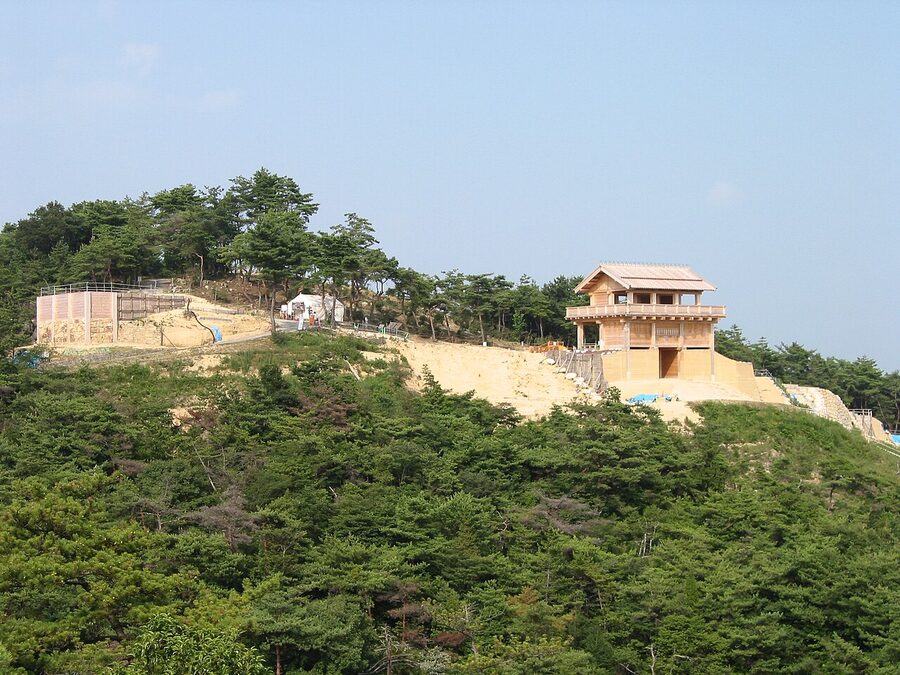

Kinojo (鬼ノ城) is the supposed fortress of Ura, the iron-smelting “ogre” of Momotaro lore. It’s not on the cycling route. You reach it by taxi from Soja Station, about thirty minutes up a steep mountain road, climbing to roughly four hundred metres above the plain. It’s a thirty-hectare Korean Baekje-style fortress, the only one of its kind preserved in western Honshu, and the archaeological evidence on site (twelve iron-smelting furnaces excavated to date) is what really anchors the “Ura was a Korean prince” reading of the Momotaro legend.
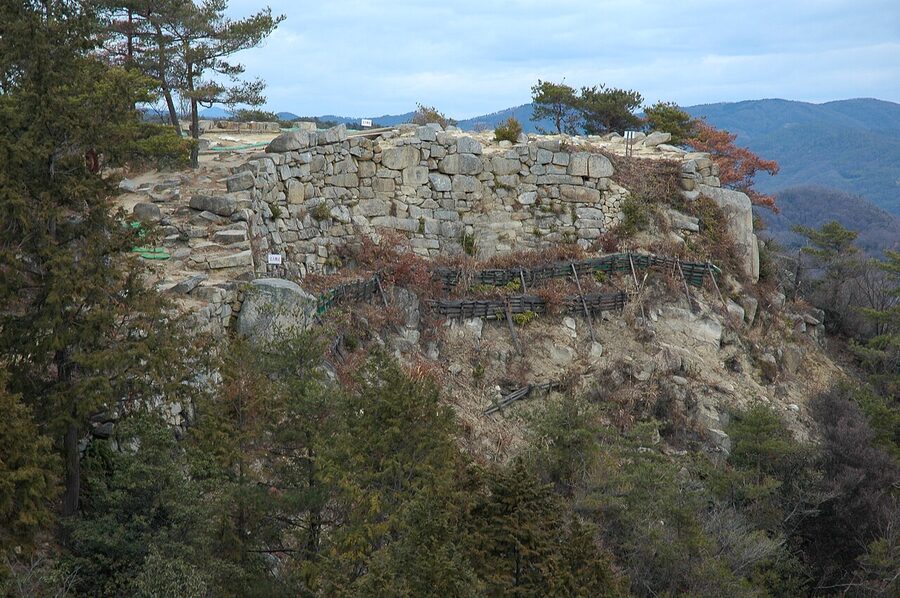

If you’ve a full second day, Kinojo is worth the trip. From the reconstructed west gate the view stretches over the entire Kibi plain to the Seto Inland Sea, with the Kojima peninsula in the foreground and Shikoku visible on a clear day. The mountain road is too steep for the rental city bikes (Araki Rent-a-Cycle’s policy explicitly excludes their bikes from the Kinojo climb), and the taxi up costs about ¥3,000 from Soja Station one-way. Don’t try to combine Kinojo with the same-day Kibi-no-michi cycling unless you started before 09:00 and rented the bike with a generous return time.
Where to eat along the way
Three things matter on this route in roughly this order: kibi-dango at the rental-shop kiosks, lunch at one of the named bakeries in Soja’s “bread town” cluster, and Okayama-bara-sushi or mamakari-sushi back at Okayama Station.
Kibi-dango
The millet dumplings that Momotaro carries in the children’s-book version of the story. You can find them at every souvenir shop in the area. The classic brand is Koeido (廣榮堂), founded 1856; their flagship store is a five-minute walk from Okayama Station’s east exit. Six pieces about ¥500. Real kibi-dango is soft and faintly sweet rather than the hard candy-coated version sold to tourists at airports. Try the original recipe before any of the modern flavours. Both Bizen-Ichinomiya station kiosk and Soja station kiosk sell them; the Soja end is the better-value purchase if you’re buying gift packs.
Soja’s “bread town” lunch stops
Soja markets itself with the slogan pan no machi (“bread town”), which sounds like a tourism-board invention until you actually visit. The town has 16 working bakeries listed on the official Soja tourism map, more per capita than anywhere comparable in western Honshu, and the locals genuinely treat bread as the regional cuisine. The cluster within ten minutes of Soja Station works as a lunch stop on the cycling day: order a sandwich and a sweet bun, sit in the small park behind the station, ride on. Reliable picks include Kojima Bakery near the station and Tsudaya in the side-streets a few hundred metres east. None take reservations; cash is fine.
Okayama-bara-sushi and mamakari-sushi
Bara-sushi is the local Okayama variant of chirashi: a scattered-rice bowl with seafood and seasonal vegetables. Mamakari is a small herring-family fish from the Seto Inland Sea, pickled in vinegar and served as nigiri. Both are available as bento at Sanstation Okayama (the food-hall complex inside Okayama Station) for around ¥1,200. For a sit-down version, the lunch counters at Okayama Station’s east exit do solid versions for ¥1,500 to ¥2,000.
Best season for the ride
Kibi-no-michi works year-round. The seasonal differences are pronounced enough to be worth thinking about.
Spring (late March to mid April). Cherry blossoms peak around the first week of April. The pagoda framed by sakura is the canonical photo. Daytime temperatures are 12–18 °C, manageable in a long-sleeve top. Crowds at the shrines are heavier than the rest of the year but still a fraction of what Kyoto sees at the same time.
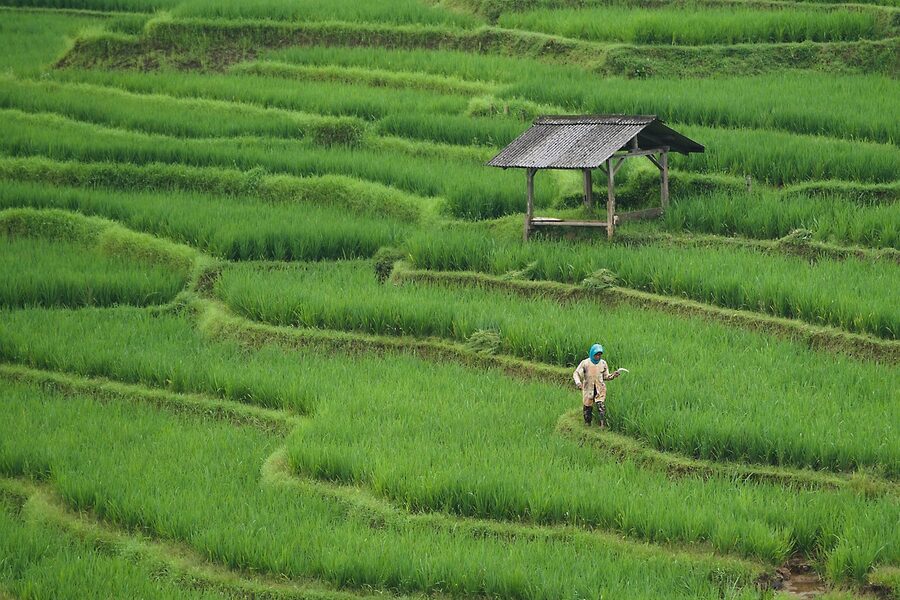
Late spring (May). Rape blossoms (yellow) line the cycle path between Bitchu Kokubunji and Soja. The rice paddies are flooded and being plowed for planting; the empty fields look strange after seeing autumn shots. Quieter than April, weather mild.
Summer (June to August). Hot. Humidity above 80% is normal in July and August, and afternoon temperatures hit 33–35 °C. Plus side: the rice is bright green, the sun shows the pagoda at its sharpest, and the route is almost empty of other riders. Start at 07:00 and finish by 11:00 if you go in summer. Carry two litres of water; the convenience-store gaps are real.
Autumn (mid October to early November). The single best window for the ride. Rice ready for harvest (gold), cosmos in flower (pink), pagoda in full Edo-period silhouette. Daytime 16–22 °C, dry. Pack a thin layer for the last hour back to Okayama.
Winter (December to February). Cold but rideable: daytime 5–10 °C, occasional ice on shaded sections of the path in early morning. The rice paddies are stubble-brown and the route looks austere. The plum blossoms (white) start opening in the precincts of Bitchu Kokubunji around late January. Bike-rental shops keep the Year-end / New-Year closure window (officially Dec 28 to Jan 5 at Uedo); confirm by phone.
Where to stay
Three options depending on the trip shape.
Kurashiki (the recommended base). The Bikan historical quarter is the most attractive small-town heart in this corner of Japan: whitewashed merchant houses, a willow-lined canal, an excellent prefectural museum, and a dinner scene that puts central Okayama in the shade. Hotel Cuore Kurashiki at the station and Ryokan Kurashiki near the Bikan are both reasonable, in different price brackets. Kurashiki to Soja is fifteen minutes by Hakubi Line; Kurashiki to Okayama is fifteen minutes by Sanyo Line. Best base if you can stretch the trip to two nights.
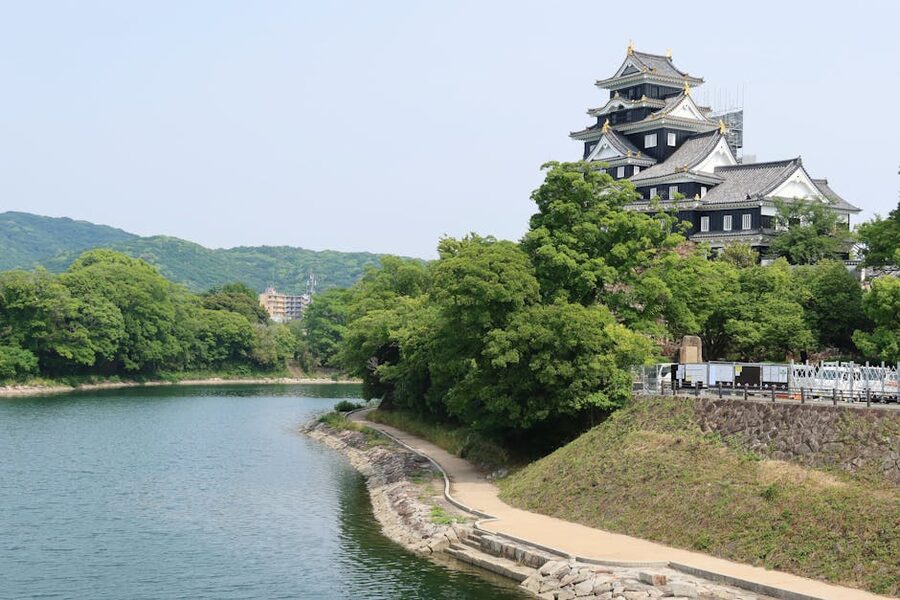
Okayama city. Practical, unremarkable, and convenient. The hotels around the east exit of Okayama Station (Granvia Okayama, Okayama Washington Hotel Plaza, plenty of cheaper business hotels) are a short walk from both shinkansen and the Kibi Line platforms. Korakuen Garden, one of the three great gardens of Japan, is a fifteen-minute walk from the station and worth pairing with the cycling day. Okayama Castle is next to Korakuen.
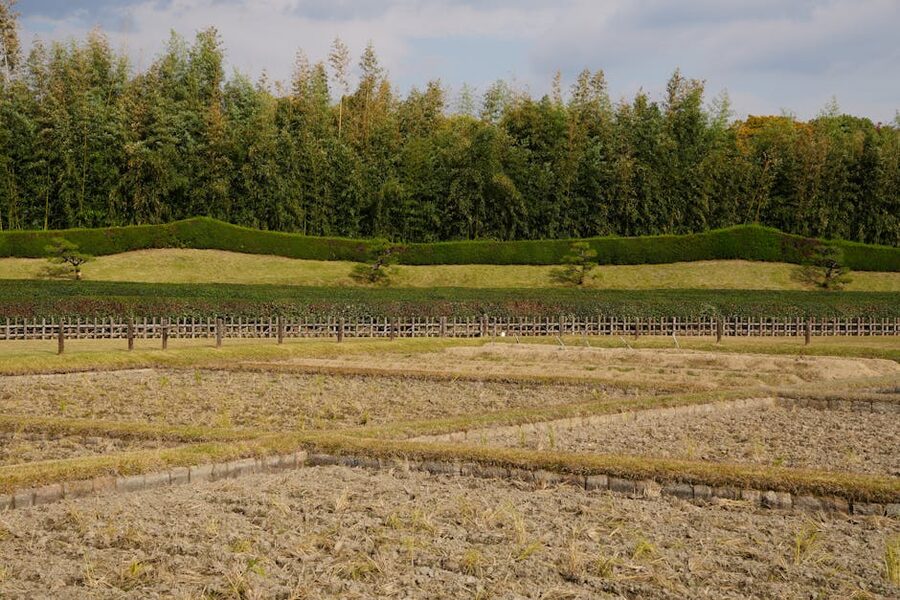
Bitchu Takamatsu / Soja. Modest business hotels and a couple of inns, fine for a single night before an early Kinojo day. Sojakan and Hotel Ikedaya Annex are the standard options near Soja Station. Worth it only if you’re combining the cycling with the Kinojo climb the morning after.
Practical answers
Do I need to reserve the bike? Not on a weekday for the standard city bike. For a sport bike, e-bike, tandem, weekend rental, or any of the eleven Kibichari, phone the day before. Reservations close three days out for the formal cancellation policy; inside that window you’ll pay 20% to 100% if you cancel. Rain forecasts are an explicit get-out if you call before the booking time.
Is the route signposted in English? The main directional signs (white and blue cycle-route markers) are bilingual. The information boards at the temples and tombs are bilingual at the major sites and Japanese-only at the smaller ones. A free Kibiji Trail Guide booklet in English, Mandarin and Korean is available at the tourism office at Okayama Station and at the rental shops; pick it up before you start.
Is it safe for kids? Yes. The trail is mostly separated cycle path, traffic is light, gradients are minimal, and the rental shops carry front and rear child seats (front: 1–4 years and under 15kg; rear: 2–6 years and under 20kg). The exceptions are the urban approach into Okayama if you ride back rather than train back, and the brief shared-road section near Okayama JCT. For kids under ten, finish at Soja and train back rather than riding the return.
Toilets? Yes, at all the major stops: Bizen-Ichinomiya station, Kibitsuhiko Shrine, Kibitsu Shrine, Bitchu Kokubunji, Tsukuriyama visitor centre, Soja station. Long gaps are not a feature of this route.
Can I do it on a road bike? Yes. The surface is paved or smooth gravel throughout, with no proper off-road sections. Twenty-five-millimetre tyres handle all of it without complaint.
Phone signal? Solid throughout. Both major Japanese carriers cover the entire route. The free Kibi-no-michi cycling-route GPX file is downloadable from the Okayama Prefecture HARE IRO Cycling site if you’d rather have turn-by-turn than read signposts.
For the broader cycling-Japan questions (train and bike rules, rental etiquette, road etiquette, the visa-free situation), see the cycling Japan FAQ.

Pair Kibi-no-michi with another route
Kibi-no-michi is short enough that you can pair it with a longer ride on the same trip. A few combinations that work geographically.
Setouchi triangle. Kibi-no-michi makes a strong half-day to bookend an Inland Sea cycling week. From Okayama, the Shimanami Kaido (Onomichi to Imabari, 70km) is two hours west by rail. The Tobishima Kaido (Hiroshima coast island-hop, 40km) sits between them. Three rides in five days is a workable Inland Sea cycling trip, with Kibi-no-michi as the cultural opener.
Other lesser-known designated cycling roads. Kibi-no-michi sits in the same category of overlooked named routes as the Keinawa Cycling Road from Kyoto to Wakayama and the Tsukuba Kasumigaura Ring Ring Road in Ibaraki. Each is a regional-government designated cycle route with its own quirks, fewer crowds, and history-dense surroundings.
Sazanami Kaido. If the Setouchi-triangle plan above appeals, the Sazanami Kaido coastal ride east of Kure makes a quieter alternative to Tobishima Kaido or a one-day add-on between Hiroshima and Onomichi.
Awaichi and Biwaichi. Two longer loops in west-central Japan, both reachable from Okayama in two to three hours. Awaichi (150km, one or two days) sits between Kobe and Tokushima. Biwaichi (200km, one or two days) is the standard test of a Japan-cycling itinerary. Either works after Kibi-no-michi as a more demanding follow-up.
Tokaido legacy ride. If your trip is built east-bound rather than west-bound, the Tokaido Tokyo–Kyoto ride finishes about three hours by rail from Okayama, and Kibi-no-michi makes a sensible coda day before flying out.
For northern routes, see Furano-Biei for the late-summer flower season in central Hokkaido.
 RoutesTsukuba Kasumigaura Ring Ring: Japan’s 180km lake loop you’ve never heard ofTake the JR Joban Line out of Tokyo Station, change at Tsuchiura, and you can be on the Ring Ring…
 RoutesSazanami Kaido: cycling Hiroshima’s coastal road east of KureForty kilometres in, the road bends inland near Aki-Tsu and the noise drops off all at once. The articulated lorries…
 RoutesKeinawa Cycling Road: Kyoto to Wakayama by bikeAt first light the Togetsukyo Bridge in Arashiyama is empty enough to ride down the middle of. The painted blue…