
Reviewed · KYOTO CYCLING TOURS
Explore Hidden Kyoto by E-Bike: Private, Scenic & Fun
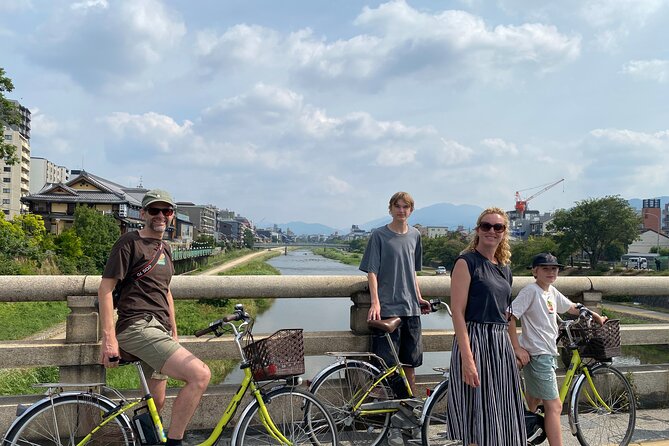
Kyoto’s best moments are often between the famous sights. This private e-bike tour links major temples with quiet lanes, old neighborhoods, river paths, and small local stops that are easy to miss on foot. Guide Yonnie is especially good with families, adjusting the pace, adding breaks, and explaining Buddhist and Shinto customs in clear, lively terms. I like the personal route and the electric assist, which lets you cover much more ground without turning the day into a workout. I also like the mix of grand sights and ordinary Kyoto, from the vermilion Heian Jingu torii to Demachi Futaba’s traditional sweets.
The main consideration is time. The advertised ride lasts about three to five hours, but one outing ran a little over five hours because the group took its time. You will also pay extra if you enter Kiyomizu-dera or other temples, and food at Demachi Futaba is not included.
In This Review
- Key things to know before you book
- Why an e-bike works so well in Kyoto
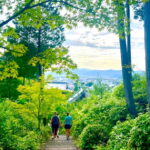
- Kiyomizu-dera: a famous start with city views
- Chion-in and Nanzen-ji: grand gates and open temple grounds
- Heian Jingu’s giant torii and Gion’s Hanamikoji Street
- Kamogawa River stepping stones: a simple local pleasure
- Shimogamo Jinja and the forest around it
- Demachi Futaba and Somei Well: local flavor beyond the big sights
- Kyoto Gyoen: a calm finish around the Imperial Palace
- How the private format changes the day
- Pace, heat, and practical comfort
- Who gets the best value from this ride
- Is the $123.57 price fair?
- Should you book Explore Hidden Kyoto by E-Bike?
- FAQ
- How long does the Kyoto e-bike tour last?
- Is this a private tour?
- Which languages does the guide speak?
- Are e-bike rental and insurance included?
- Are temple and shrine entrance fees included?
- Is food included?
- What happens if the weather is poor?
Key things to know before you book
- Private ride with a flexible feel: Only your group takes part, so the guide can adjust the pace and focus.
- E-bikes cover serious ground: You can connect southern Higashiyama, Gion, northern shrines, and Kyoto Gyoen in one outing.
- Yonnie is a strong family guide: The pace can be slowed for children, with breaks on hot days.
- A useful mix of famous and quiet Kyoto: Kiyomizu-dera and Chion-in share the route with Somei Well and local wagashi.
- Temple entry costs extra: The tour includes the bicycle and insurance, not admission tickets.
- Weather matters: Poor weather can lead to a new date or a full refund.
Why an e-bike works so well in Kyoto
Kyoto is flat in many places, but its sights are spread across a wide basin. Walking from Kiyomizu-dera to Shimogamo Jinja would take time and energy. Public transport can get you close, but it does not always reach the narrow lanes and river crossings that give Kyoto its character.
The e-bike solves that problem. You still see the city at street level, but you can move between districts without spending half the day on foot. The electric motor is especially useful in the heat, for families, and for anyone who wants to save energy for temple visits.
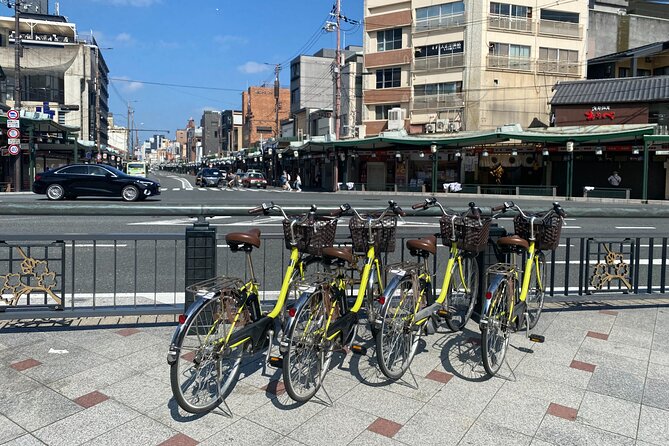
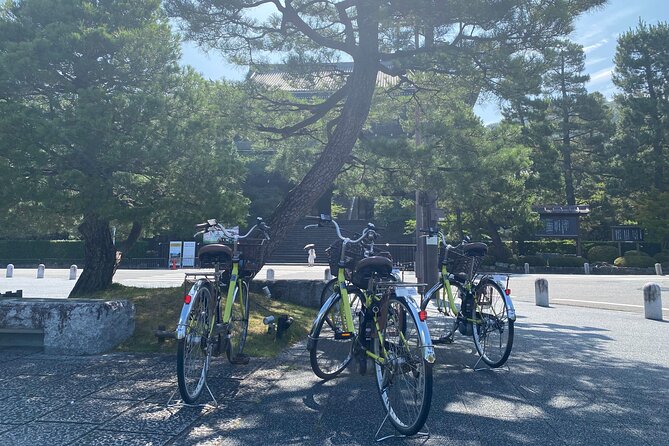
This is not a race. The best part of the ride is the ability to stop often. Your guide can pause near a gate, shrine entrance, river view, or quiet street and explain what you are seeing. The supplied bicycle rental and insurance are included, which makes the $123.57 price easier to assess.
That price is not a bargain basement bike rental. It pays for a private guide, an e-bike, insurance, and several hours of sightseeing. For a family or small group splitting the cost, it can be a sensible way to see a broad slice of Kyoto in limited time.
A few more Kyoto tours and experiences worth a look
Kiyomizu-dera: a famous start with city views
Kiyomizu-dera is one of Kyoto’s must-see temples, and the tour stops near it for about 45 minutes. Your guide explains the temple and points out the celebrated wooden stage, which looks across the city from its hillside setting.
The important detail is that admission is not included. You can discuss with your guide whether you want to enter, but you should budget separately for the ticket. Even from the outside and nearby viewpoints, the area gives you a strong introduction to Kyoto’s temple architecture and hillside setting.
Kiyomizu-dera is also one of the busiest parts of the route. The e-bike does not make the immediate temple approach empty or calm. What it does is help you spend less time getting there, then move on to quieter streets afterward.
Chion-in and Nanzen-ji: grand gates and open temple grounds
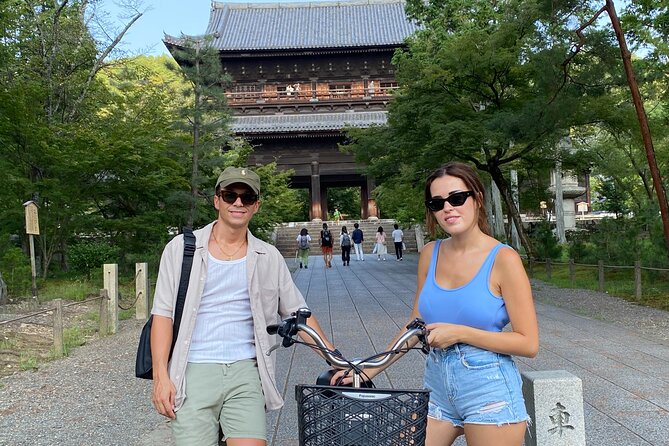
The ride continues to Chion-in, the head temple of the Jodo Pure Land Buddhist sect. The Sanmon Gate is the visual star here. It is described as Japan’s largest wooden gate, and its scale gives you a quick sense of how much power and wealth major religious institutions once held.
The stop lasts about 15 minutes, and admission is free for the included portion. You may not have time to explore every building, so think of this as a focused introduction rather than a full temple visit.
At Nanzen-ji, you get roughly 30 minutes in the outer grounds. The massive Sanmon Gate is again the first major sight, with views from its upper level. The spacious temple grounds make a welcome contrast to the tighter lanes around Gion and Kiyomizu-dera.
Nanzen-ji is a good place to listen. Your guide can connect the buildings, gardens, and Buddhist traditions in a way that turns a quick stop into something more meaningful. If you are passionate about temple design or religious history, tell the guide early so the route can give those interests more attention.
Heian Jingu’s giant torii and Gion’s Hanamikoji Street
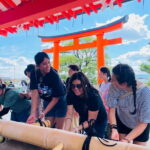
The Grand Torii of Heian Jingu is a short stop, about 10 minutes, but it offers one of the route’s strongest photo opportunities. The vermilion gate rises 24 meters and marks the approach to a shrine linked with Kyoto’s imperial past.
You do not need a long visit to appreciate its scale. The stop is useful because it gives you a different type of Kyoto image after the wooden temple gates at Chion-in and Nanzen-ji.
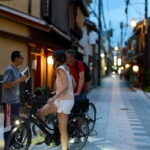
Hanamikoji Street brings you into Gion, Kyoto’s best-known traditional entertainment district. The cobblestone street is lined with wooden townhouses, and your guide explains the area’s geisha culture and older architecture.
Keep your camera respectful here. Hanamikoji is a real neighborhood, not a stage set. The tour gives you context, but the short stop is mainly for orientation and atmosphere rather than a full Gion walk.
Kamogawa River stepping stones: a simple local pleasure
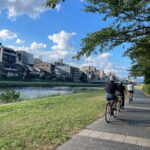
One of the most appealing stops is at the Kamogawa River’s stepping stones. People cross the water by hopping from stone to stone, and the river offers a calmer view of the city than the temple districts.
This is a small moment, but it helps the tour feel less like a checklist. You get a chance to pause, look at the water, and watch a familiar local activity. The stones may not suit everyone, so use care and follow your guide’s advice.
The river also helps connect the southern and northern parts of the route. An e-bike ride along or near the Kamogawa makes the distance between Gion and Shimogamo feel manageable.
A few more Kyoto tours and experiences worth a look
Shimogamo Jinja and the forest around it
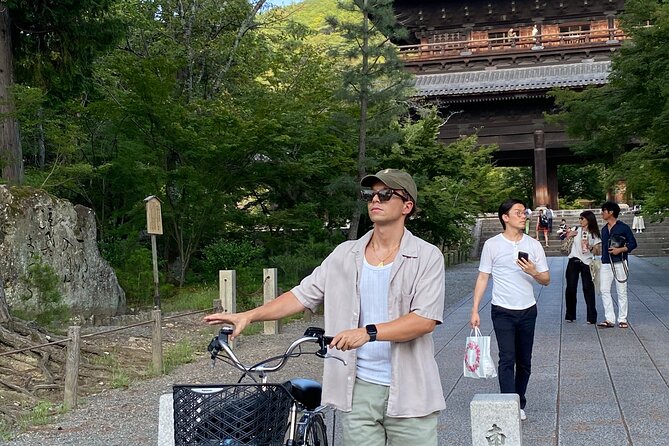
Shimogamo Jinja is one of Kyoto’s oldest and most important Shinto shrines. It sits within an ancient forest and is recognized as a UNESCO World Heritage site.
The stop lasts about 45 minutes, giving you more time than the quick torii and street visits. Your guide can explain the difference between Shinto shrine customs and Buddhist temple practices, a point that many first-time visitors find confusing.
The setting also changes the mood of the tour. After city streets, large gates, and Gion’s traditional storefronts, the shrine’s wooded approach feels quiet and spacious. If photography matters to you, this is one of the places to mention when discussing your preferred route.
The shrine is free to visit as part of the tour. As with every stop, your guide can provide the local context, but the time is still limited compared with a dedicated shrine tour.
Demachi Futaba and Somei Well: local flavor beyond the big sights
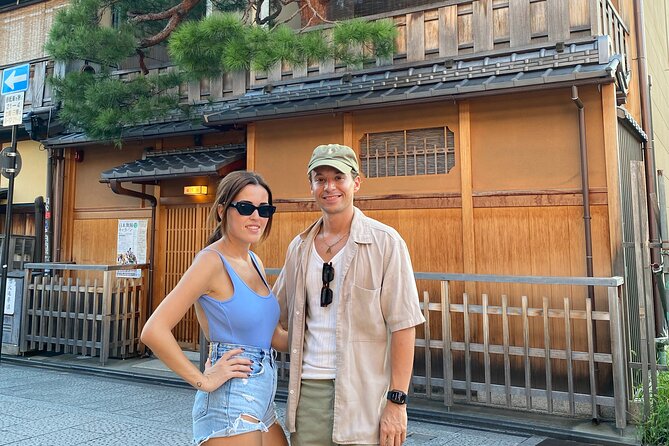
Demachi Futaba is a traditional wagashi shop near the Kamogawa River, with almost 200 years of history. Wagashi are Japanese sweets, often made with carefully prepared beans, rice, or seasonal ingredients.
Food is not included, but you can buy something if the shop is open and the schedule allows. A mochi stop was a highlight for one family, and it is easy to see why. Trying a small local sweet gives the ride a taste of daily Kyoto rather than only its monuments.
Do not treat this as a guaranteed meal break. The tour does not provide meals, snacks, or drinks, so bring your own water and plan to pay for any sweets separately.
Somei Well is a brief stop near Kyoto Gyoen. This old water source dates to the early Edo period, around the 1600s, and was valued for its clean water. It is not a major attraction that demands a long visit. Its value comes from the story and the reminder that Kyoto’s past is found in modest places as well as famous temples.
Kyoto Gyoen: a calm finish around the Imperial Palace
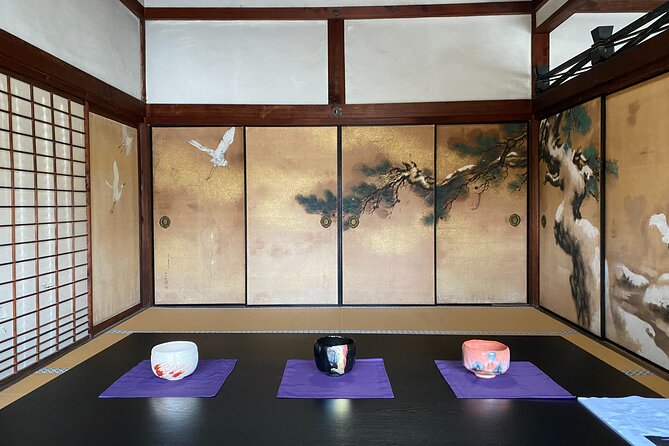
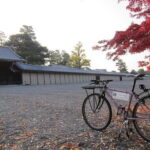
The final major stop is Kyoto Gyoen National Garden, the broad park surrounding the Kyoto Imperial Palace. You spend about 30 minutes riding or pausing in the garden while your guide explains its role in the city.
This is a good ending because the open park gives you breathing room after the denser temple and shopping districts. It also lets the e-bike show its full value. You can cover more of the garden than you would comfortably manage on foot, while still moving slowly enough to notice the setting.
Kyoto Gyoen is free to visit. The tour does not promise entry to every palace building or a separate Imperial Palace program, so clarify your expectations if that is a top priority.
How the private format changes the day
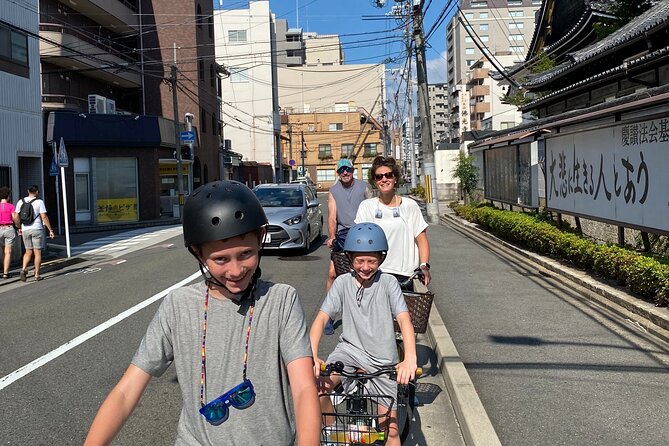
This is a private activity, so only your group participates. That matters more than it might seem. A guide can slow down for children, stop for photos, or spend more time on Buddhist traditions, Shinto customs, architecture, or local food.
Yonnie has shown particular care with families. On a very hot day, the pace was relaxed, breaks were added, and the ride extended beyond five hours. That flexibility is a real advantage, but you should not assume every outing will follow the shortest three-hour schedule.
The route can be shaped around photography, history, or local culture. Be specific at the start. If you want major temple views, say so. If you prefer quiet lanes and neighborhood details, say that instead. The more clearly you explain your interests, the more useful the private format becomes.
The listed guide languages are English, Indonesian, and Malay. The guide named in the supplied material is Yonnie, sometimes written as Yonni. If having a guide in a particular language matters to you, confirm it when booking.
Pace, heat, and practical comfort
The tour is described as suitable for most people, but you still need to be comfortable riding a bicycle for several hours. You will get on and off the bike at temples, shrines, streets, and river stops.
Kyoto can be very hot. One outing took place in difficult heat, and the guide adjusted the speed and built in rests. That is encouraging, but bring water, sun protection, and clothing suited to the weather. Drinks and food are not included.
The experience requires good weather. If poor weather forces cancellation, you are offered another date or a full refund. For a full refund when you cancel yourself, you need to cancel at least 24 hours before the start time. Changes made inside that window are not accepted.
The tour has mobile ticketing and is near public transportation. Parking is not included if free parking is unavailable, so public transport is the simpler choice unless you have a specific reason to drive.
Who gets the best value from this ride
I would choose this tour if you have only two or three days in Kyoto and want to see several districts without spending all your time on trains and buses. One family used it during a short two-day stay and covered many places that felt less crowded than the standard sightseeing route.
It also suits families. The electric assist reduces the physical strain, and Yonnie’s relaxed pace has worked well with children. A three-hour version may be a good target for younger riders, while older children and adults may be happy with the longer route.
This is less ideal if you want deep, unhurried visits inside every temple. The itinerary includes many stops, and several are short. You will see more places, but you will not have the time of a full-day temple specialist tour.
It may also be a poor fit if you dislike cycling, hot weather, or frequent transitions. The e-bike makes the route easier, not effortless. You should also add admission money for Kiyomizu-dera or any other paid temple entry and carry cash or another payment method for optional sweets.
Is the $123.57 price fair?
For one person, $123.57 is a substantial half-day expense. The value improves when you consider what is bundled: a private guide, an e-bike, insurance, and a route that links southern Higashiyama, Gion, the Kamogawa, northern Kyoto, and Kyoto Gyoen.
A self-guided bicycle rental would cost less, but it would not provide the same explanations, route planning, or local stops. You would also need to plan the connections yourself and decide which temples and shrines fit into the available time.
The tour earns its price if you care about efficiency and personal attention. It earns less if you plan to visit only one or two temples, or if you would be happy riding without a guide.
Should you book Explore Hidden Kyoto by E-Bike?
Book it if you want a private, active way to see both famous Kyoto and quieter corners in one half-day. The strongest reasons are the flexible route, the family-friendly pace, the mix of temples and everyday places, and the chance to ride like a local rather than simply follow a bus route.
Before booking, decide how much riding your group wants, tell the guide your main interests, and budget for temple entry, drinks, and optional sweets. If the forecast is hot, allow extra time and bring water.
I would especially recommend it to first-time visitors on a short stay, families with school-age children, and repeat visitors who have already seen the main central sights. If your priority is a slow, scholarly visit inside each temple, choose a more focused walking tour instead.
FAQ
How long does the Kyoto e-bike tour last?
The tour lasts approximately three to five hours. The exact duration can vary, and one outing ran a little over five hours after the guide adjusted the pace and added breaks.
Is this a private tour?
Yes. Only your group participates in the activity.
Which languages does the guide speak?
The tour provides English, Indonesian, and Malay-speaking guides. A guide named Yonnie is associated with the experience.
Are e-bike rental and insurance included?
Yes. The use of an e-bike and insurance are included in the tour price.
Are temple and shrine entrance fees included?
No. Entrance fees are not included if you choose to enter temples or other paid sites. Several listed stops have free admission.
Is food included?
No. Meals, snacks, and drinks are not provided. Purchases at places such as Demachi Futaba are extra.
What happens if the weather is poor?
The tour requires good weather. If it is canceled because of poor weather, you will be offered a different date or a full refund.
More Backstreet & Hidden Rides in Kyoto


More E-Bike Tours in Kyoto
More Kyoto Cycling Tours in Kyoto
More tours in Kyoto we've reviewed

Kyoto Cycling Tours, compared.
 ★ 5.0Bike Tour Exploring North Kyoto plus LunchFrom $106
 ★ 5.05 Top Highlights of Kyoto Full Day Bike Tour (E-bike option)From $172
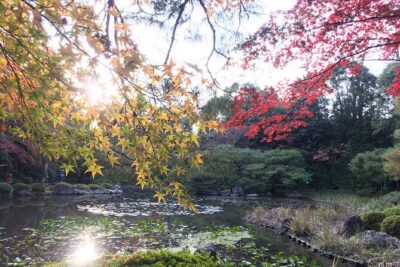 ★ 5.0E-Bike Tours of the highlights of Kyoto!!!From $109
 ★ 5.0Afternoon Kyoto Bike Tour: Bamboo Forest, Monkeys & Hidden SpotsFrom $106
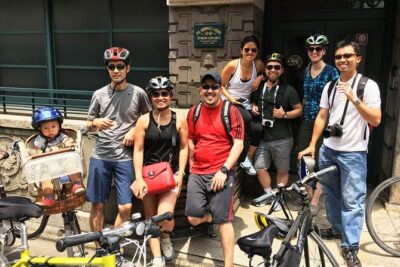 ★ 5.0South Kyoto in a Nutshell: Gentle Backstreet Bike Tour!From $79
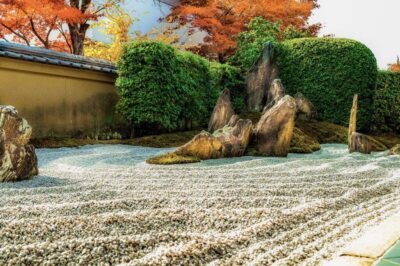 ★ 4.9Kyoto: City Secrets eBike TourFrom $1273h 45m
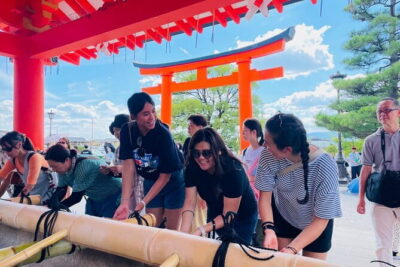 ★ 5.0Pedal Adventure Kyoto’s iconic landmarks on an e-bike tourFrom $86
 ★ 4.9Kyoto: Hidden Gems E-Bike Tour with Local Japanese GuideFrom $753h 30m
Browse the lists this tour appears in