
Reviewed · KYOTO CYCLING TOURS
Kyoto: Half-day Guided Bike Tour with Fushimi Inari
Fushimi Inari’s orange torii gates are the headline, but the best part of this 210-minute bike tour is the route between the famous sights. You pedal along the Takase Canal and Kamo River, cut through Gion’s backstreets, and reach temples that can feel far apart on foot.
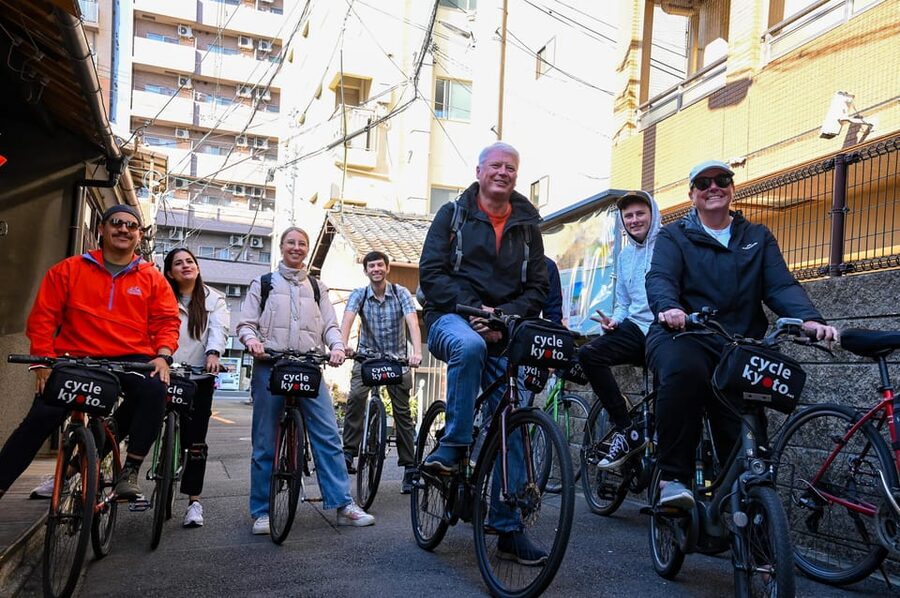
I like the small group, capped at eight people, and the gentle pace reported by guests who rode with guides including Jay, Julian, Indra, Sean, Juan, and Mayco. I also like that the tour gives you a look at Kyoto beyond its postcard stops, including local streets and riverside stretches.
The main consideration is fitness. One participant covered more than 15 kilometers, and you need to be comfortable cycling for several hours. The tour is not suitable for children under 13, people with back problems, or anyone who cannot ride a bike.
In This Review
- Key points at a glance
- Why this route works so well in South Kyoto
- Starting near Kyoto Station
- Toji, Kyoto’s oldest temple
- Higashi-Honganji and the quiet canal route
- Gion from the backstreets
- Tofukuji’s temple views
- Rolling into Fushimi Inari
- What the guides add
- Price, pace, and overall value
- Who should book this bike tour?
- FAQ
- How long does the Kyoto bike tour last?
- What attractions does the tour visit?
- Is the tour conducted in English?
- How many people can join the tour?
- What is included in the price?
- Can I use an e-bike?
- What should I bring?
- Who cannot join the public tour?
- Should you book it?
Key points at a glance
- Fushimi Inari by bicycle: Finish at Kyoto’s famous shrine, with time to walk among the orange torii gates.
- A quiet route through Gion: See the geisha district from narrow backstreets rather than only its main roads.
- Five major stops: Visit Toji, Higashi-Honganji, Takase River, Kamo River, Tofukuji, and Fushimi Inari.
- Small English-speaking group: With no more than eight participants, it is easier to ask questions and stay together.
- Well-equipped bikes: Bicycle rental, helmet, water, and a small pouch for personal items are included.
- E-bike option: Ask in advance about an electric bicycle, available for an additional 3,000 yen.
Why this route works so well in South Kyoto
Kyoto is easy to admire and surprisingly hard to move around. Its major temples and shrines are spread across the city, while buses can be crowded and walking between districts takes time. A bicycle gives you a useful middle ground: faster than walking, more open than a bus, and slow enough to notice ordinary streets.
This route focuses on South Kyoto, beginning near Kyoto JR Station and returning to the same area. You do not spend the whole ride on major roads. The route uses the Takase Canal, the Kamo River, neighborhood streets, and back lanes near Gion.
I especially like the way the sights are arranged. Toji and Higashi-Honganji provide a temple-heavy start. Gion and the rivers offer a change of pace. Tofukuji adds another major temple, and Fushimi Inari gives you the most instantly recognizable finish.
The tour lasts three and a half hours, including the safety briefing and guided stops. That is long enough to cover a lot of ground without taking your entire day. You should still expect a real bike ride, not a quick sightseeing spin.
A few more Kyoto tours and experiences worth a look
Starting near Kyoto Station
The meeting point is Cycle Kyoto, reached from Kyoto JR Station by walking past Avanti, crossing one set of traffic lights, passing the Daily Yamazaki convenience store, and taking the next left. Give yourself enough time to find it, since the directions depend on recognizable street landmarks rather than a large station sign.
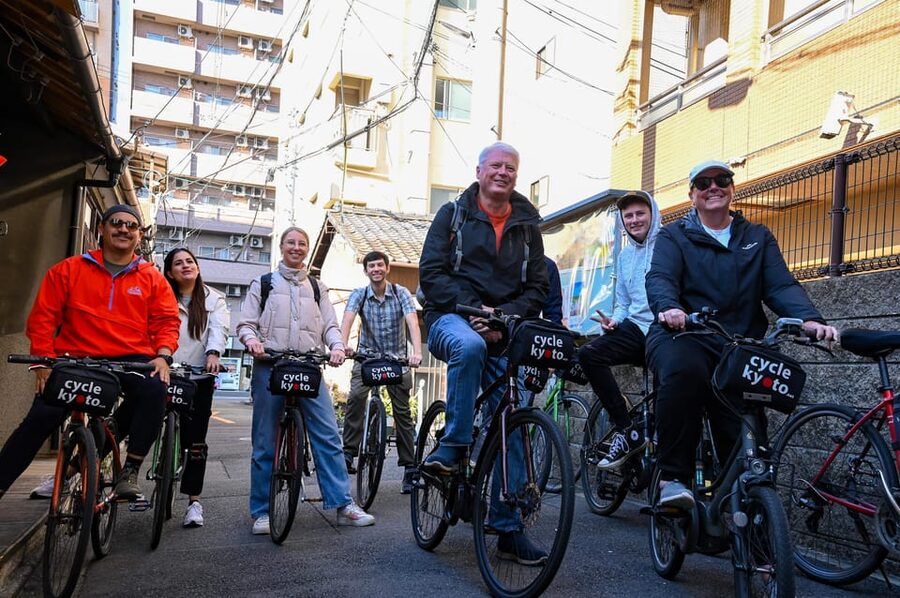
The tour begins with a 15-minute safety briefing. This is useful in Kyoto, where you will share space with cars, pedestrians, and other bicycles. You receive your bicycle, helmet, and water, and the bicycle has a small pouch for personal items.
The minimum age for a public tour is 13. Wear comfortable clothing and shoes suitable for pedaling. Sunscreen and warm clothing are sensible additions, since conditions can change during the ride. Check the weather before leaving your hotel.
An e-bike is available by request for a 3,000-yen upgrade fee. That is worth considering if you are unsure about riding more than 15 kilometers, though the tour is described as gentle rather than strenuous. The standard bicycle should suit confident riders who are comfortable staying in the saddle for several hours.
Toji, Kyoto’s oldest temple
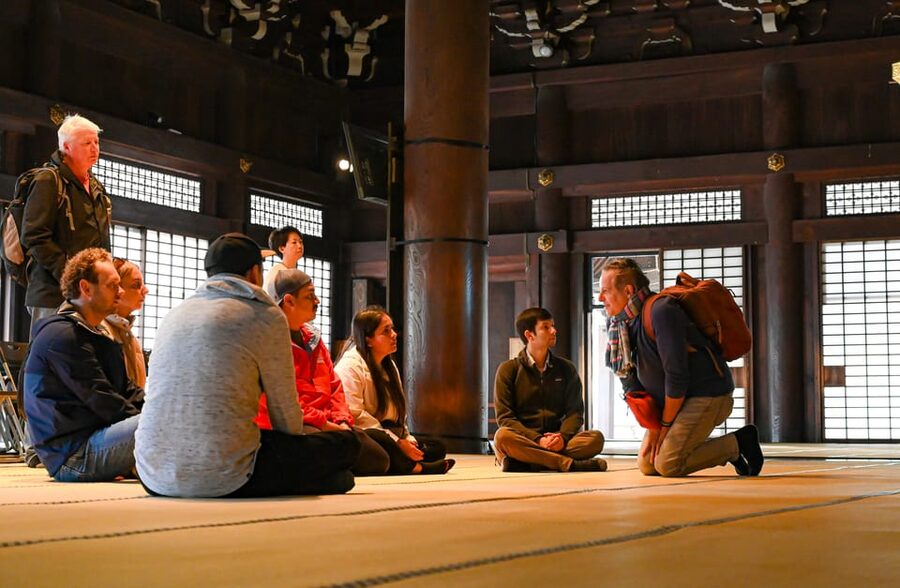
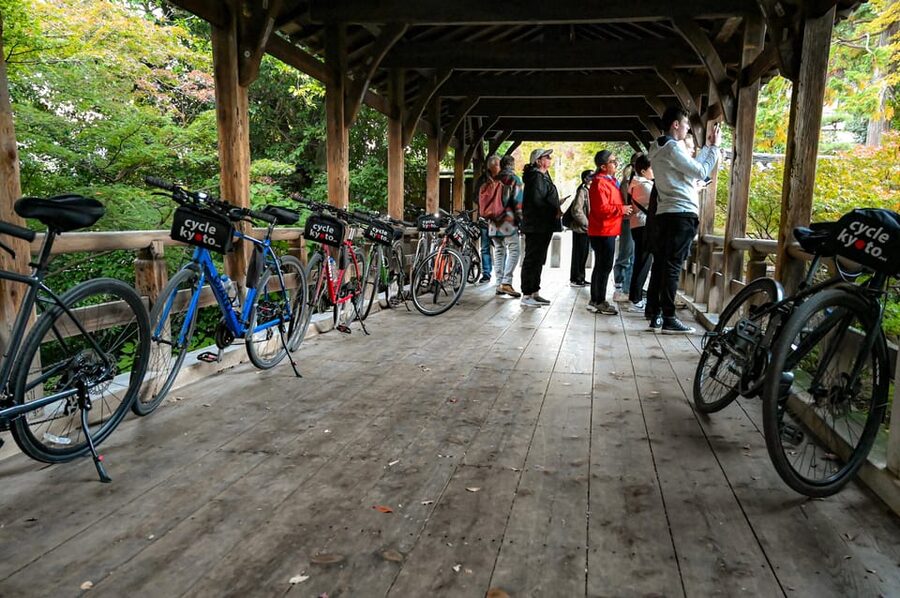
Toji is the first major stop, with about 35 minutes for a guided visit. It is a UNESCO World Heritage site and is described as Kyoto’s oldest temple, making it a fitting introduction to the city’s religious architecture.
The stop is more than a quick photograph. A guide can help you understand what you are looking at and point out details that are easy to miss when you move from one famous building to another. The time is long enough for a proper look, though not long enough for an unhurried exploration of every corner.
Toji also shows why a bicycle is helpful here. You arrive from the station area without spending time changing buses, then leave efficiently for the next temple. If you are keen on temple interiors or want extended time at each site, the fixed schedule may feel brisk. For a first look at several important places, it is a sound trade.
Higashi-Honganji and the quiet canal route
The next guided stop is Higashi-Honganji, one of Japan’s largest temples, with about 35 minutes. Its scale gives the morning a different feel from Toji, and the guide’s explanation helps place the temple within Kyoto’s religious and cultural life.
After the temple, the ride follows the Takase Canal for roughly 10 minutes. This is one of the route’s most appealing transitions. You are no longer simply moving from one formal sight to another. The waterway brings you into the city’s everyday side, where the scenery is less monumental and the bicycle feels especially natural.
The route then reaches the Kamo River for about 15 minutes. The river stop is brief, but it breaks up the temple visits and gives you a chance to enjoy open space. I would not book this tour expecting long periods beside the water. These are short visits within a packed route, but they help the morning feel varied.
Gion from the backstreets
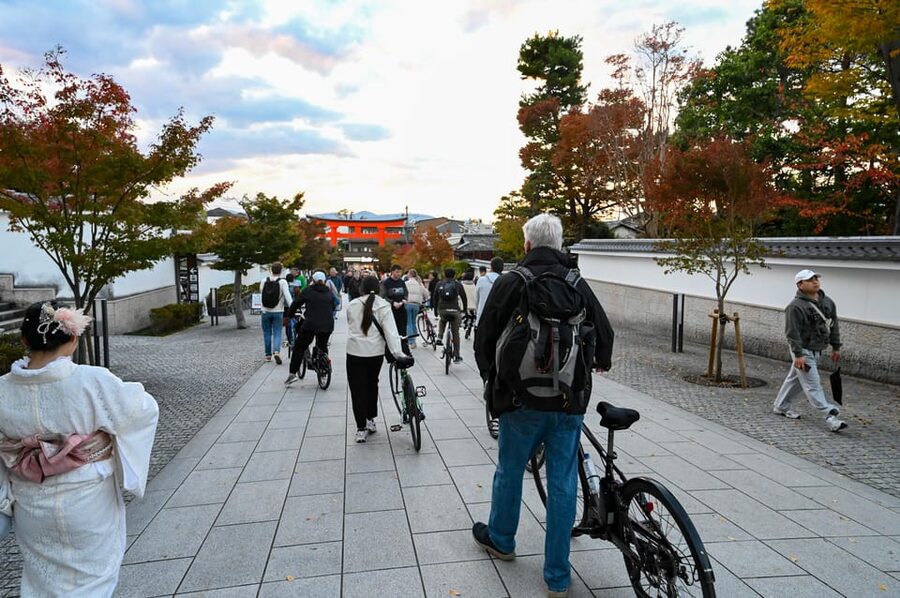
Gion receives about 30 minutes of guided attention. This is Kyoto’s famous geisha and teahouse district, but the experience is not limited to its best-known lanes. The ride moves through backstreets, giving you a different view of the area than a straight walk along its busiest approaches.
That distinction matters. Gion can feel polished and carefully presented around its famous streets. On a bicycle, you see how the district connects with nearby neighborhoods, canals, and river routes. You also cover more ground than you would on foot.
Your guide is an important part of this section. Past tours have been led by Jay, Julian, Indra, Sean, Juan, and Mayco, among others, and the strongest praise centers on guides who explain Kyoto’s history and culture while keeping the mood relaxed. Jay was singled out for making people feel comfortable and included, while Julian was praised for making the most of poor weather.
Remember that Gion is a living district, not only a backdrop for photographs. Follow the guide’s directions, ride carefully, and keep the pace comfortable for the group. The small size helps, since a group of eight is easier to manage in narrow streets than a large procession.
A few more Kyoto tours and experiences worth a look
Tofukuji’s temple views
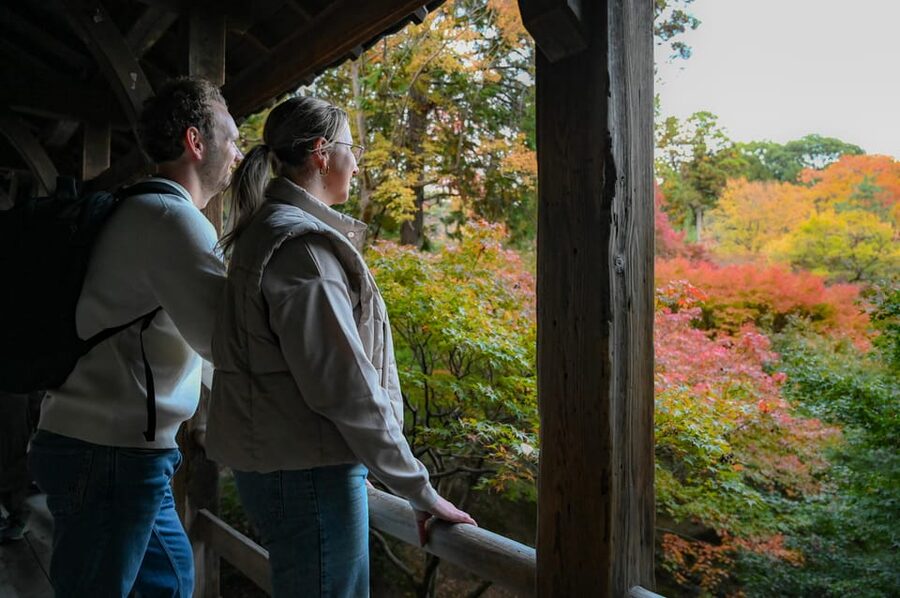
Tofukuji is a 30-minute photo stop. The timing tells you what to expect: this is a chance to see the temple and take pictures, not a long formal visit with a detailed interior tour.
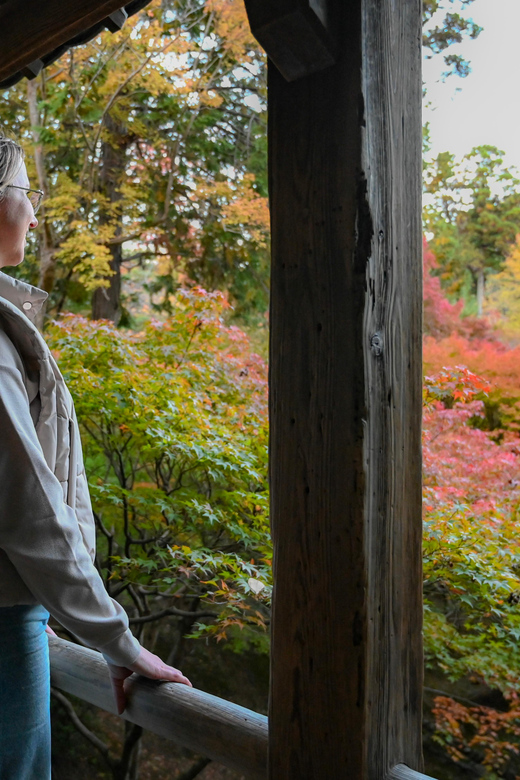
Tofukuji is one of the most attractive points on the route, especially for anyone who enjoys temple design and carefully framed views. You reach it after the canal, river, and Gion sections, so the change back to a large religious complex feels welcome.
The stop also shows the practical strength of this itinerary. Tofukuji is close to the route toward Fushimi Inari, and the bicycle lets you connect the two without treating them as separate excursions. You get a useful look at the area rather than spending the morning walking back and forth.
If photography is your main reason for visiting Tofukuji, tell the guide early. Thirty minutes passes quickly, particularly if you want time for both pictures and quiet observation.
Rolling into Fushimi Inari
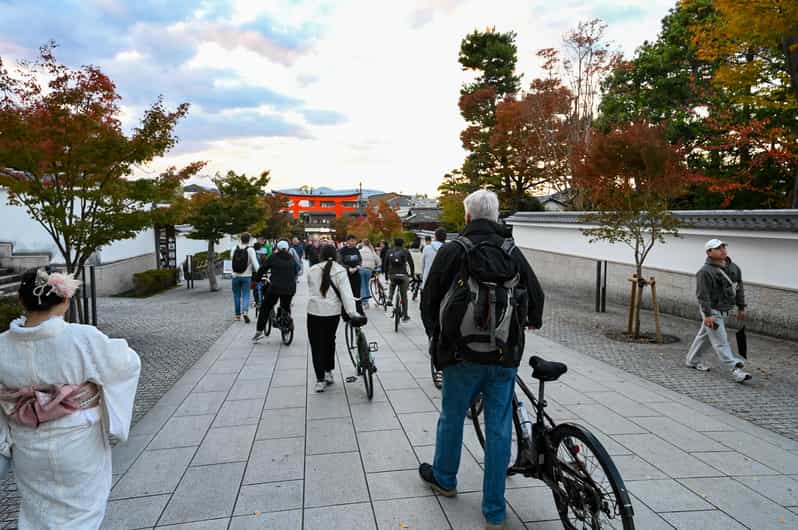
The final major stop is Fushimi Inari Taisha, with about 45 minutes for a guided visit. The shrine is famous for its endless-looking rows of orange torii gates, and this is the part of the tour most people are waiting for.
The bicycle takes you into the Fushimi Inari area, but you explore the gates on foot. That matters because bikes cannot replace the walking portion. Wear shoes that you can use comfortably for both cycling and a shrine visit.
Forty-five minutes gives you time to stroll among the most famous torii gates and take photographs. It is not a full climb through every section of the mountain paths. If you want to walk far beyond the main gate corridors, plan a separate visit on another day.
Ending here is smart. Fushimi Inari is one of Japan’s most visited attractions, and reaching it after a route through South Kyoto makes the shrine feel like part of a wider neighborhood rather than an isolated photo stop. The tour then returns to Cycle Kyoto.
What the guides add
The guide is the reason to choose this tour instead of renting a bicycle on your own. You could find Toji, Gion, Tofukuji, and Fushimi Inari independently, but you would need to plan the connecting route and decide where to stop.
The guides named in the feedback include Jay, Julian, Indra, Sean, Juan, and Mayco. Jay received praise for his passion and for making everyone feel comfortable. Indra was appreciated for answering questions and adding local details. Sean adjusted the pace for a small group and helped one rider arrange an e-bike upgrade.
Those details give you a useful picture of the guiding style. Expect an English-speaking guide who explains the sights, answers questions, and manages the ride rather than simply leading you from one pin on a map to the next.
Guide quality can vary from person to person, as it does on any guided activity. Still, the repeated praise for clear explanations, patience, and an easygoing manner is a strong reason to choose the guided format.
Price, pace, and overall value
At $77 per person, the tour is not the cheapest way to see Kyoto’s temples. You are paying for the bicycle, helmet, water, guide, route planning, and the convenience of linking several districts in one morning.
I think the price makes sense if you value context and efficient transport. The tour includes several major sights, but you are not paying entrance fees or meals, since meals are not included and no food stop is part of the schedule. You should budget separately for any admission costs that apply at the sites.
The small group improves the value. With a maximum of eight people, the guide can answer questions and make modest adjustments. One small group had only four people and enjoyed a gentle pace with more time at selected stops. That kind of flexibility cannot be guaranteed, but a smaller group gives it a better chance.
The main limit is time. You see many places in 210 minutes, but you will not experience each one at length. Think of this as a well-organized introduction to South Kyoto, followed by the option to return independently to the place that interests you most.
Free cancellation is available up to 24 hours before departure, and you can reserve while paying later. Starting times vary, so check availability when booking.
Who should book this bike tour?
I would recommend it to confident cyclists who want to see a lot of Kyoto without spending the whole day on buses. It suits first-time visitors who want an overview, as well as repeat visitors who prefer side streets, riversides, and neighborhood connections over a standard sightseeing route.
It is also a good choice if you like having a guide explain cultural details along the way. The route has enough variety to keep the morning moving: temples, water, traditional streets, a large shrine, and a final walk through the torii gates.
I would be cautious if you have back problems, cannot ride a bicycle, dislike fixed schedules, or want long visits inside each temple. Children under 13 cannot join the public tour. If weather looks poor, check conditions before departure and dress accordingly. The tour can still run in less-than-perfect weather, but rain changes the comfort of any bicycle ride.
FAQ
How long does the Kyoto bike tour last?
The tour lasts 210 minutes, or three and a half hours, including the 15-minute safety briefing and the guided stops.
What attractions does the tour visit?
The route includes Toji, Higashi-Honganji Temple, the Takase River, the Kamo River, Gion, Tofukuji Temple, and Fushimi Inari Taisha.
Is the tour conducted in English?
Yes. The tour includes a live English-speaking guide.
How many people can join the tour?
It is a small-group tour limited to eight participants.
What is included in the price?
Bicycle rental, a helmet, a guide, and water are included. Meals are not included.
Can I use an e-bike?
E-bikes are available upon request for an additional fee of 3,000 yen.
What should I bring?
Bring comfortable clothing, comfortable shoes, warm clothing, sunscreen, and a camera. Wear clothing suitable for biking and check the weather before departure.
Who cannot join the public tour?
Children under 13, people with back problems, and people who cannot ride a bicycle should not join this tour.
Should you book it?
Book this tour if you want a practical, active way to connect South Kyoto’s major sights and quieter streets. The mix of Toji, Gion, Tofukuji, riverside riding, and Fushimi Inari gives you a much broader morning than visiting one shrine by taxi.
Skip it if you want a slow temple day or do not enjoy cycling. For everyone else, the small group, well-maintained bicycles, flexible guide style, and strong 4.9 rating make this a well-priced introduction to Kyoto by bike. An e-bike upgrade is the sensible choice if distance or hills concern you.
More Cycling Tours in Kyoto


More Temple & Shrine Rides in Kyoto
More Kyoto Cycling Tours in Kyoto
More tours in Kyoto we've reviewed

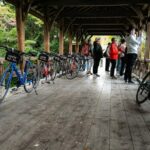
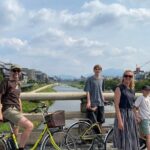
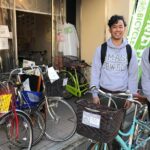
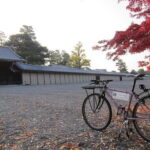
Kyoto Cycling Tours, compared.
 ★ 5.0Bike Tour Exploring North Kyoto plus LunchFrom $106
 ★ 5.05 Top Highlights of Kyoto Full Day Bike Tour (E-bike option)From $172
 ★ 5.0E-Bike Tours of the highlights of Kyoto!!!From $109
 ★ 5.0Afternoon Kyoto Bike Tour: Bamboo Forest, Monkeys & Hidden SpotsFrom $106
 ★ 5.0South Kyoto in a Nutshell: Gentle Backstreet Bike Tour!From $79
 ★ 4.9Kyoto: City Secrets eBike TourFrom $1273h 45m
 ★ 5.0Pedal Adventure Kyoto’s iconic landmarks on an e-bike tourFrom $86
 ★ 4.9Kyoto: Hidden Gems E-Bike Tour with Local Japanese GuideFrom $753h 30m
Browse the lists this tour appears in