
Reviewed · HIROSHIMA CYCLING TOURS
Hiroshima in a Nutshell: Morning Bike Adventure
The smartest part of this Hiroshima tour is its route. A bicycle lets you connect the Peace Memorial Park, Atomic Bomb Dome, Hiroshima Castle, and Shukkei-en Garden in one morning, without waiting for buses or covering every stretch on foot.
I like the small maximum of eight riders, which keeps the group personal and makes it easier to ask questions. I also like the guide-led history, especially the old photographs and careful explanations around the Peace Park. The main drawback is that the tour involves repeated stops and getting on and off the bikes, and an e-bike costs extra if you need more help on hot days.
In This Review
- Key points at a glance
- Why a bicycle works so well in Hiroshima
- Starting at 10:00 at Cycle Hiroshima
- Peace Memorial Park: a quiet beginning
- The Atomic Bomb Dome in ten focused minutes
- Hiroshima Castle and its garden setting
- Shukkei-en: a calmer final stop
- What the guiding is really like
- How hard is the riding?
- Is $72.96 a fair price?
- Small practical details that matter
- Who should book this Hiroshima bike tour?
- Should you book it?
- FAQ
- How long does the Hiroshima bike tour last?
- Where does the tour start and finish?
- What is included in the tour price?
- Which sights does the tour visit?
- Are children allowed to join?
- What happens if bad weather cancels the tour?
- What is the cancellation policy?
Key points at a glance
- Covers four major sights in one morning: The route links Hiroshima’s main historic and cultural stops in about 3 to 4 hours.
- Peace Park comes first: You have time for quiet reflection, old photographs, and an explanation of how the area looked before World War II.
- Small group of eight or fewer: Guides such as Awais, James, Melissa, Yuki, and Ihsan have been praised for clear explanations, good pacing, and personal attention.
- Flat city riding: The cycling is not described as demanding, though you should be comfortable on a standard bicycle.
- Useful extras are included: Your bike, helmet, bottled water, and Shukkei-en admission are covered.
- E-bike option may cost more: An e-bike has been available for an additional ¥2,000, with limited supply, so ask about it before riding.
Why a bicycle works so well in Hiroshima
Hiroshima is an easy city to explore, but its key sights are spread out. The Peace Memorial Park and Atomic Bomb Dome sit near the center, while Hiroshima Castle and Shukkei-en are farther away. Walking between all of them can eat up much of a short visit.
The bike solves that problem neatly. You can move through the city at street level, follow canals, cut through quieter areas, and reach places that are less convenient by car or bus. You get a better feel for Hiroshima as a living city, not just a collection of memorials.
This is also a useful first morning in town. The route gives you a basic map in your head, points out the main sights, and leaves you with choices for the afternoon. You might return to the Peace Memorial Museum, spend more time at the castle, or simply wander through central Hiroshima with a better sense of direction.
The ride is generally at a steady pace rather than a race. A guide named Awais led one group over roughly 6.81 miles in four hours, including stops and explanations. That gives you a fair idea of the amount of ground a bike can cover here, though the exact route and timing can vary.
A few more Hiroshima tours and experiences worth a look

Starting at 10:00 at Cycle Hiroshima
The tour begins at Cycle Hiroshima, at 4-chōme-5-4 Ōtemachi in Hiroshima’s Naka Ward. The start time is 10:00 am, and the tour ends back at the same meeting point.
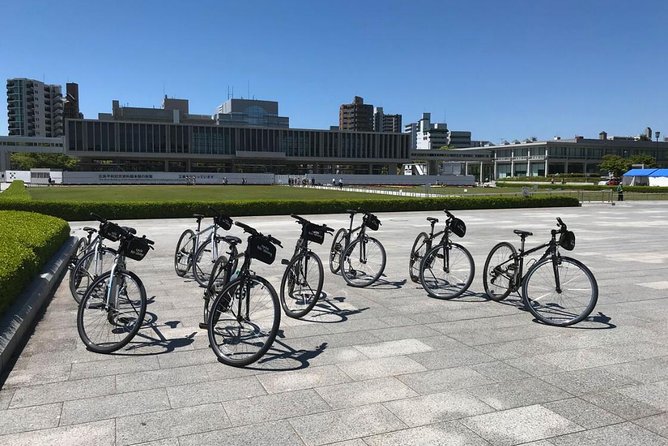
Allow a little extra time to find the shop and get settled. You will be fitted with a bicycle and helmet, and guides have been careful about adjusting seat height and checking that riders understand the hand signals. That opening safety check matters in a city ride, especially if you have not cycled in Japan before.
The included bottled water is a welcome touch, particularly in Hiroshima’s hot and humid months. Wear clothing that lets you pedal comfortably, and bring sun protection if the forecast is bright. The route is mostly flat, but this is still several hours of activity, with repeated stops and starts.
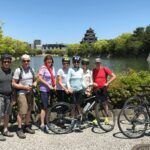
The group limit is eight people. That is small enough for a guide to keep an eye on the group and answer questions without turning every stop into a lecture for a crowd. Different guides lead the route, including Awais, James, Melissa, Yuki, Ihsan, Amy, and Levi. Their styles vary, but the strongest part of the experience is the mix of practical cycling help and detailed local history.
Peace Memorial Park: a quiet beginning
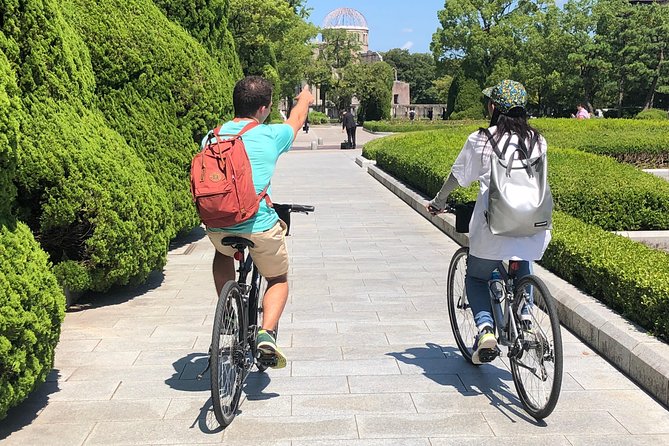
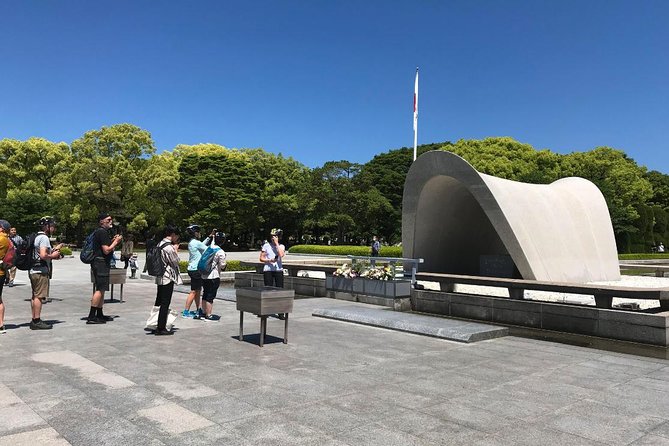
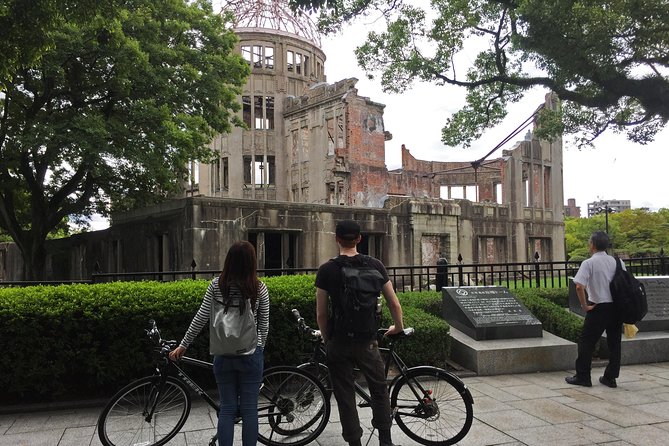
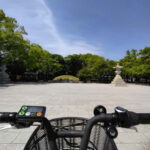
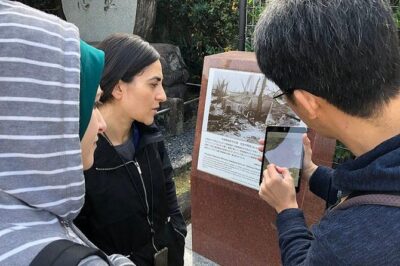
The first major stop is Hiroshima Peace Memorial Park. The ride through the park is intentionally slow and quiet. You stop for about 20 minutes while the guide explains the site and shows old pictures of the area before World War II.
That use of historic images gives the park more context. Hiroshima was not simply an empty memorial site before 1945. It was a busy urban district, and seeing what stood here before the bombing helps you understand the scale of what was lost.
This part of the tour can feel heavy, and that is appropriate. The guides have been praised for handling the subject with care while also explaining the city’s rebuilding and later efforts toward peace. The tone is generally thoughtful rather than sensational.
You should not expect enough time here for every memorial, monument, and museum display. The stop is an introduction, not a full Peace Museum visit. If the park matters most to you, plan to come back later and give it several hours on your own.
The cycling format helps in one practical way: you do not have to spend your first morning walking long distances between the park’s major points. You can pause at the selected areas, listen, and save your energy for a longer return visit.
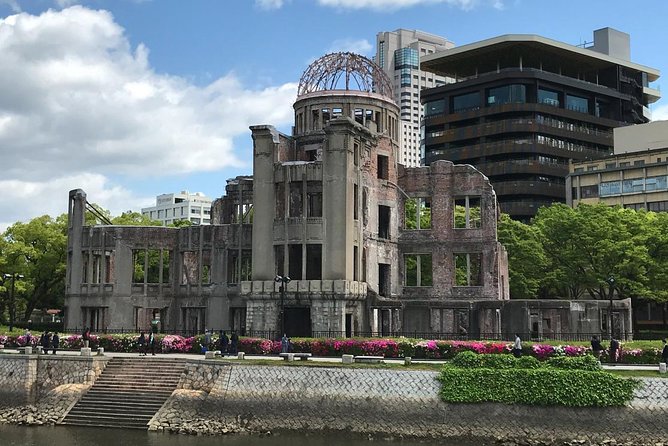
The Atomic Bomb Dome in ten focused minutes
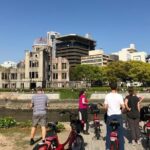
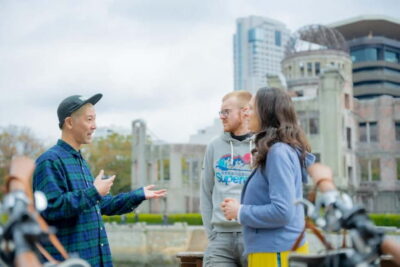
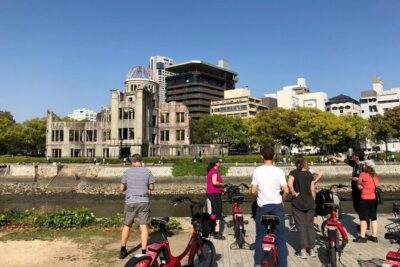
The Atomic Bomb Dome receives a short stop of about 10 minutes. It is one of Hiroshima’s most recognizable structures, and the tour gives you time for photographs and quiet thought.
The building’s damaged frame is powerful in person. Its location beside the river also makes it easy to understand how closely the bombing affected the center of the city. A guide can add the basic historical setting, but the stop is brief, so do not treat it as a substitute for the Peace Memorial Museum or a longer visit around the park.
Ten minutes is enough for an introduction and pictures. It may feel rushed if you want to examine the structure closely or read every nearby plaque. The advantage is that you keep moving, which allows the tour to reach the castle and garden before lunch.
The guides have received strong praise for answering questions about the bombing, its aftermath, and Hiroshima’s recovery. One guide, Levi, began with a history lesson before the cycling began, while others have explained the monuments at each stop. You can expect the historical content to be a major part of the morning, not an occasional comment between attractions.
Hiroshima Castle and its garden setting
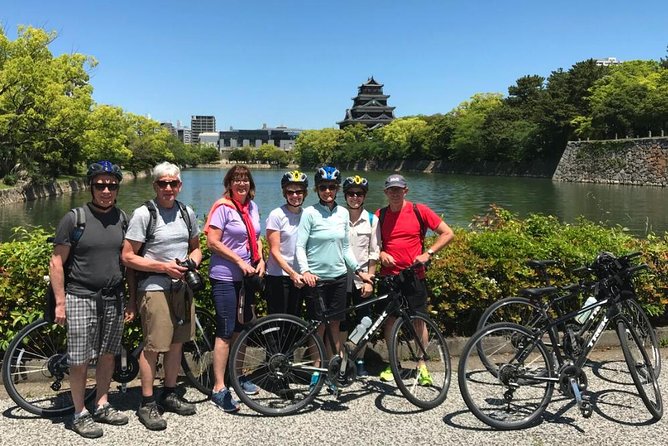
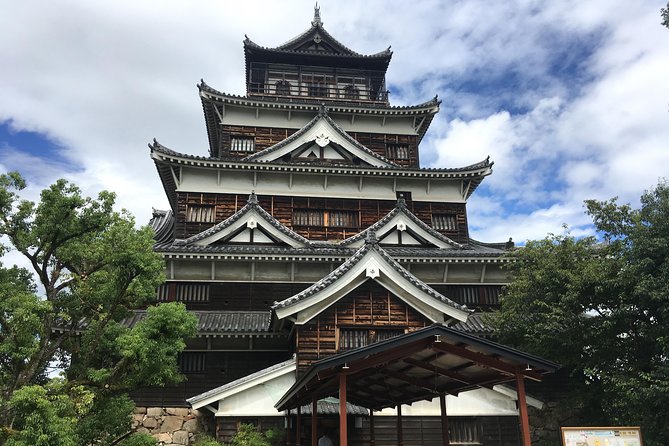
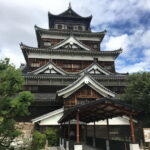
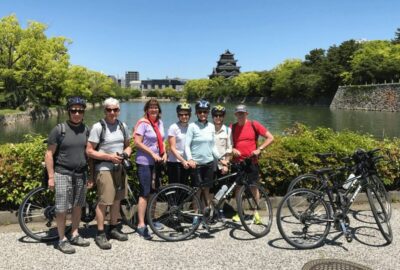
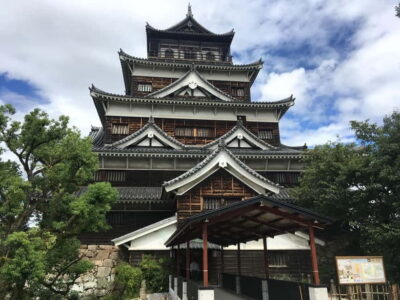
Next comes Hiroshima Castle, with about 25 minutes to ride through the grounds, see the exterior, and learn about its past. The castle gives the tour a different side of Hiroshima. After the solemnity of the Peace Park, you move into the city’s older political and cultural story.
The grounds offer good photo opportunities, and the ride lets you approach the castle through its surrounding greenery rather than arriving only at a ticket entrance by car or bus. The stop is mainly an outdoor visit. The supplied details do not promise a full interior tour or castle admission, so you should not expect an extended look inside the main building.
That limitation is worth knowing if castles are your priority. You will get a useful overview and time for pictures, but not a slow, museum-style visit. The bike route is designed to show several sides of Hiroshima in one morning, not to give each attraction a full half-day.
I like the contrast here. Hiroshima Castle reminds you that the city’s story did not begin in 1945. The castle grounds bring in earlier chapters and make the morning feel broader than a single memorial route.
Other cycling tours in Hiroshima
Shukkei-en: a calmer final stop
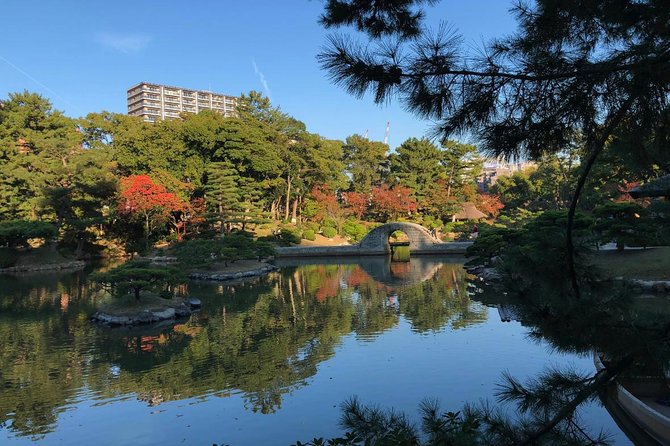
The final listed stop is Shukkei-en, a formal Japanese garden with an included admission fee. You spend about 25 minutes here, looking at the greenery and learning how Japanese gardens use balance, scale, and carefully arranged views.
After the Peace Park and castle, Shukkei-en provides a quieter finish. The garden is not just a patch of lawn. Its design gives the guide a chance to explain how Japanese gardens create changing scenes as you move through them.
Twenty-five minutes gives you an introduction, but it is not enough for a leisurely garden visit. If you enjoy ponds, bridges, and garden design, you may want to return later. The advantage of visiting with a guide is that you receive a quick explanation of what to notice instead of simply passing through without context.
Admission is included, which adds a little value to the tour price. It also means you can visit a paid cultural attraction without having to arrange a separate ticket during a tightly timed morning.
What the guiding is really like
The strongest praise for this experience has focused on the guides. Awais has been singled out for his detailed explanations, friendly manner, and willingness to take photographs. James has been described as professional, attentive, and especially good at safety instructions. Melissa has led families with energy and care, while Yuki has been praised for taking time with the main sites.
That range matters because this is not simply a bike rental with a map. The guide shapes the experience. You receive hand signals, bike adjustments, route assistance, and a running explanation of Hiroshima’s past and present.
The historical discussion is generally presented as balanced and respectful. One rider felt that some points became too political and found the discussion uncomfortable as an American. That is a fair consideration. Hiroshima’s history involves war, responsibility, memory, and national perspectives. You should expect serious conversation, not a light sightseeing script.
At the same time, the guides appear to keep the mood human. Stories, questions, photographs, and small touches such as making origami cranes have been part of some tours. The result is a morning that can be emotional without being grim from start to finish.
English ability varies by guide, but the experience details identify an English-speaking guide, and the named guides have been described as clear and easy to speak with. If detailed historical discussion is important to you, the guide’s approach will have a large effect on your morning.
How hard is the riding?
The city route is mostly flat, and several riders have described the pace as comfortable and not rushed. You do not need to be a serious cyclist. The bigger issue is basic comfort on a bicycle for several hours, including stopping, restarting, and riding through city streets.
The tour may include a fair amount of cycling, but the sightseeing itself is broken into short sections. You will get off the bike many times. One rider felt the route had too many stop and start moments and suggested combining some parts. That is the trade-off for seeing several sights rather than riding continuously.
Standard bikes are included, along with helmets and water. An e-bike may be available for an additional ¥2,000, but supply can be limited. If you are out of practice, visiting during a hot spell, or worried about keeping pace, ask about the e-bike before the tour date rather than waiting until the morning.
The stated minimum height is 140 centimeters, and children aged 12 and under are not recommended. A 12-year-old did complete the ride on a standard bicycle in hot weather, but that should not be taken as a guarantee that every child will find it comfortable. Use the height rule and your child’s cycling ability as the practical guide.
Is $72.96 a fair price?
At $72.96 per person, this is not the cheapest way to see Hiroshima. You are paying for a small-group tour, a bicycle and helmet, bottled water, an English-speaking guide, and admission to Shukkei-en.
The value improves if you have only one day or two in the city. A walking route covering the same sights would take longer and leave you more tired. Public transport can reach many places, but you would lose the guide’s continuous commentary and the chance to ride through smaller streets and canal areas.
The price is also easier to justify if history is central to your visit. The guide connects the memorials, old photographs, castle grounds, and garden design into one morning. You can then spend the afternoon on the places that deserve more time.
It is less useful if you already know Hiroshima well or prefer to explore every site at your own speed. The short stops are designed for orientation. You will still need separate time for a full museum visit or a slow look around the garden and castle.
The extra e-bike fee is the one cost to keep in mind. The standard bike is included, but an e-bike may require another ¥2,000 and may not be available at the last minute.
Small practical details that matter
The activity uses a mobile ticket, and booking confirmation is received at the time of booking. Hotel pickup and drop-off are not included, so you need to reach Cycle Hiroshima on your own.
The tour requires suitable weather. If rain or other poor conditions cause cancellation, you can choose another date or receive a full refund. A minimum number of riders is also required, and a cancellation for that reason comes with the option of another date or experience, or a full refund.
For your own cancellation, you must cancel at least 24 hours before the local start time for a full refund. Changes or cancellations made inside that 24-hour window are not accepted for a refund.
I would avoid scheduling this tour on the same morning as a tight train departure. The ride normally ends back at the meeting point after 3 to 4 hours, but one guide extended a tour to finish the explanations. Another guide helped a rider who was worried about reaching a bullet train, but that kind of help should not be part of your plan.
Who should book this Hiroshima bike tour?
I would choose this tour if you are visiting Hiroshima for a short time and want a clear first look at the city. It is especially useful for first-time visitors who want the Peace Park and Atomic Bomb Dome but also hope to see the castle and Shukkei-en without spending the entire day walking.
It also suits people who enjoy learning while moving. The cycling is not the main event. The real appeal is combining efficient transport with a guide who can explain the meaning behind each place.
Families with teenagers may find it a good fit. One family completed the tour with teenage sons who stayed engaged, and the small group makes it easier to keep everyone involved. Younger children are not recommended, and riders below 140 centimeters cannot join.
I would think twice if you dislike bicycles, tire quickly in warm weather, or want long, unhurried visits at each attraction. In that case, a private walking or car-based plan may suit you better, though it will not offer the same easy movement through the city’s smaller streets.
Should you book it?
Book this morning ride if you want efficient sightseeing with serious historical context. The route covers the key memorial sites, adds Hiroshima Castle and Shukkei-en, and uses a bicycle to link places that are awkward to combine on foot.
The best reasons to choose it are the small group, steady pace, included equipment, and strong guide-led explanations. Plan extra time later for the Peace Memorial Museum and any stop that catches your attention. Ask about an e-bike early if you need one, and leave a generous cushion before your next train.
For a short Hiroshima visit, this is a sensible way to get your bearings and see a wide slice of the city in one thoughtful morning.
FAQ
How long does the Hiroshima bike tour last?
The experience lasts approximately 3 to 4 hours and begins at 10:00 am.
Where does the tour start and finish?
It starts at Cycle Hiroshima, 4-chōme-5-4 Ōtemachi, Naka Ward, Hiroshima, 730-0051, Japan. The activity ends back at the same meeting point.
What is included in the tour price?
An English-speaking guide, bicycle, helmet, bottled water, and admission to Shukkei-en Garden are included.
Which sights does the tour visit?
The route includes Hiroshima Peace Memorial Park, the Atomic Bomb Dome, Hiroshima Castle, and Shukkei-en Garden.
Are children allowed to join?
Children aged 12 and under are not recommended for this activity. Riders under 140 centimeters cannot participate.
What happens if bad weather cancels the tour?
You will be offered an alternative date or a full refund if poor weather causes the tour to be canceled.
What is the cancellation policy?
You can cancel at least 24 hours before the local start time for a full refund. Cancellations or changes made less than 24 hours before the start are not accepted for a refund.
More Cycling Tours in Hiroshima
More Hiroshima Cycling Tours in Hiroshima
More tours in Hiroshima we've reviewed

Hiroshima Cycling Tours, compared.
 ★ 5.0Hiroshima 2hr Peace Cycling Tour with Local GuideFrom $59
 ★ 4.8Hiroshima: Peace Cycling Tour with Local GuideFrom $522 - 3 hours
 ★ 5.0Hiroshima and Miyajima by Bike and BoatFrom $142
 ★ 5.0Hiroshima 3hr Peace Cycling Tour with Local GuideFrom $85
 ★ 4.9Hiroshima: Best of Hiroshima Guided Bike TourFrom $703h 30m
 ★ 5.0Hiroshima Country Cycling: Explore Rural Life 1 HR from CityFrom $85
 ★ 5.0Hiroshima: City and Miyajima Bike and Boat TourFrom $1387h 30m
 ★ 5.0Hiroshima Scenic Cycling Guided TourFrom $73
Browse the lists this tour appears in