
Reviewed · HIROSHIMA CYCLING TOURS
Hiroshima 3hr Peace Cycling Tour with Local Guide
Hiroshima’s story becomes more understandable when you see how far the atomic bomb’s destruction reached, then ride through the city that grew back around it. This three-hour e-bike tour links famous memorials with quieter sites that are easy to miss on foot.
I like the small group, capped at 10, and the way the route moves beyond the Peace Park to Hiroshima Castle, the Red Cross Hospital, surviving trees, and railway cars still in use. I also like the personal touch of guides such as Shin and Moe, whose family connections give the history a human voice. The main drawback is that the tour covers a serious subject at a fairly brisk pace, with some stops lasting only 10 or 15 minutes.
In This Review
- Key points at a glance
- Why cycling changes the way you see Hiroshima
- Starting at the Peace Memorial Park Rest House
- Hiroshima Castle and Gokoku Shrine
- Central Park, Aioi Bridge, and the Atomic Bomb Dome
- Riverside Hiroshima and the trees of Higashisenda Park
- The Red Cross Hospital and the Atomic Bomb Window Frame Monument
- Surviving trains, Miyuki Bridge, and the edge of destruction
- The surviving weeping willow and Peace Boulevard
- The guides make the history personal
- Is the $85.89 price good value?
- Weather, timing, and practical limits
- Who should book the Peace Cycling Tour?
- FAQ
- Where does the Hiroshima Peace Cycling Tour begin?
- Where does the tour finish?
- How long is the cycling tour?
- How many people can join the tour?
- Is the bicycle electric?
- What height is required to use an adult bicycle?
- What happens if it rains?
- Can I cancel for a full refund?
Key points at a glance
- Personal local storytelling: Guides including Shin, Moe, Toma, Kana, and Thomas explain Hiroshima’s past through facts, family memories, and the city’s recovery.
- Easy electric bicycles: The mostly flat route makes it possible to cover far more ground than you could on foot, even in warm weather.
- Fourteen meaningful stops: You see major landmarks such as the Atomic Bomb Dome, along with lesser-known places like the Atomic Bomb Window Frame Monument and a surviving weeping willow.
- Small-group format: The mixed group has a maximum of 10 people, creating room for questions and a more personal exchange.
- Rain alternative: Poor weather can mean a walking peace route focused on the hypocenter and nearby memorial sites, or a full refund.
- Useful planning detail: The morning outing runs from 10:00 to 13:00, with an afternoon departure at 14:00 and return at 17:00.
Why cycling changes the way you see Hiroshima
Hiroshima’s central sights are spread along rivers, parks, bridges, and broad streets. Walking between them can take time, especially once you have spent an hour or two at the Peace Memorial Museum and park. An electric bicycle gives you a wider view without turning the outing into a workout.
The route is described as gentle and relatively flat. The e-bikes are easy to use, and the electric assist is especially helpful in summer heat. You still need to be comfortable riding a bicycle, but you do not need to be a strong cyclist.
The group rides at a shared pace. If someone is less confident, particularly a child, the guide may slow down. That is considerate, though it means the exact schedule can shift. The bikes have accident insurance included in the price, another small benefit for an urban ride.
The bicycles may feel undersized to some taller adults. That point matters because comfort can affect your enjoyment over three hours. Adult electric bicycles require a height of at least 145 centimeters. Children between 110 and 145 centimeters can use one of the two available children’s bicycles, while child seats are offered for children under 22 kilograms and under 115 centimeters.
A few more Hiroshima tours and experiences worth a look

Starting at the Peace Memorial Park Rest House
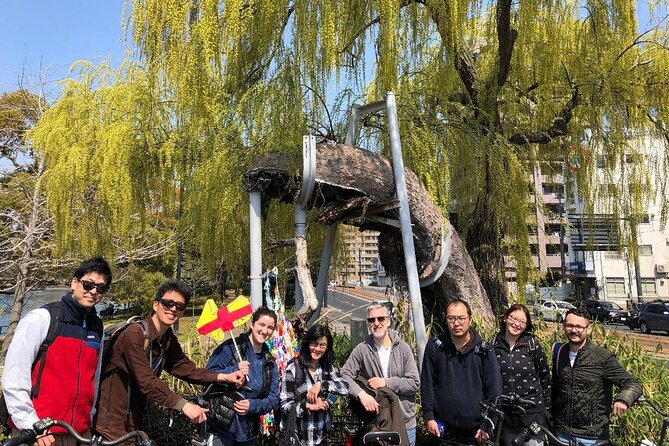
Meet at the Hiroshima Peace Memorial Park Rest House at 10:00 for the morning departure. The afternoon departure is scheduled for 14:00. The activity returns to this same point, which makes it easy to continue with the Peace Memorial Museum, lunch, or another Hiroshima sight afterward.
The opening briefing takes about five minutes. You meet the guide and the rest of the group, hear the route plan, and receive safety instructions. The supplied information also refers to temperature checks and other health procedures, though the timetable can change depending on conditions on the day.
Arrive early. If you are late without advance notice, the tour can be canceled with a full same-day charge. There is no luggage storage at the Rest House, but coin lockers are available at the International Conference Center Hiroshima and the Hiroshima Peace Memorial Museum, about a six-minute walk away.
Hiroshima Castle and Gokoku Shrine
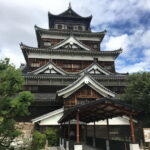
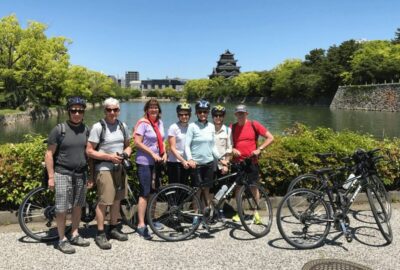
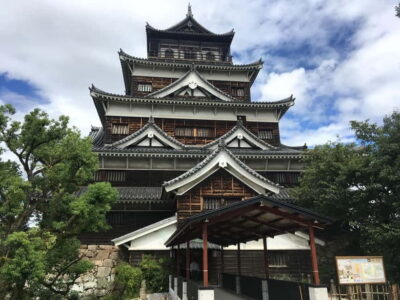
The first ride takes you to Hiroshima Castle, a useful opening because it places the wartime story in a wider setting. The castle site was a military center, and it was the first location to report the atomic bombing. You have about 20 minutes here, enough for the guide to explain the military situation and the castle’s role without turning the stop into a long castle visit.
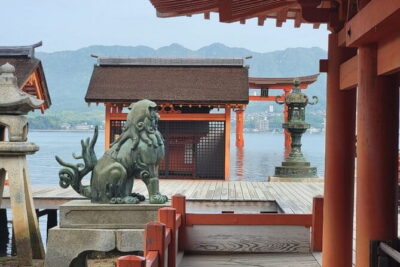
Next comes Hiroshima Gokoku Shrine and its gate. This 15-minute stop focuses on details that can easily escape notice if you are moving from one major attraction to the next. A guardian dog statue and the shrine gate survived the blast, giving the guide a chance to explain how isolated objects endured while much of the surrounding city was destroyed.
I like this early section because it adds prewar and wartime context before the route reaches the most familiar memorials. The tradeoff is that the short stop does not allow much time for independent exploration.
Central Park, Aioi Bridge, and the Atomic Bomb Dome
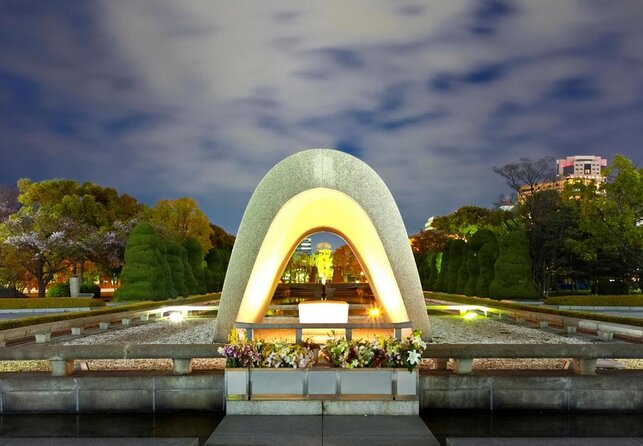
Hiroshima Central Park offers a change of mood. You walk through a broad green space for about 20 minutes, seeing the city’s trees and open areas before returning to the harder facts of August 6, 1945.
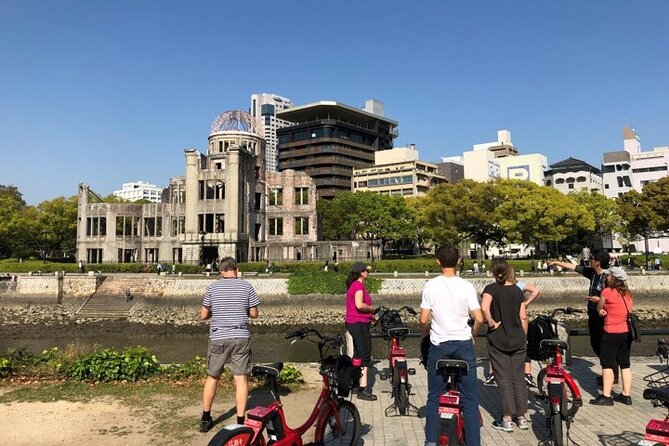
At Aioi Bridge, the guide explains the bridge’s importance as the intended target of the bomb. The bridge and river remain, allowing you to connect the historical account to a real place rather than only a museum display.
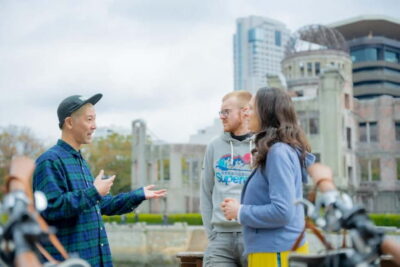
The Atomic Bomb Dome follows. You spend about 15 minutes here, hearing accounts of local people and the memories attached to the building. This is one of the most powerful stops, but it is also a place where the schedule may feel tight. If you want extended time around the Dome, plan to return on your own after the tour.
The bike helps here because you are not spending your energy walking between each site. You can listen, look, and keep moving through the city’s story.
Riverside Hiroshima and the trees of Higashisenda Park
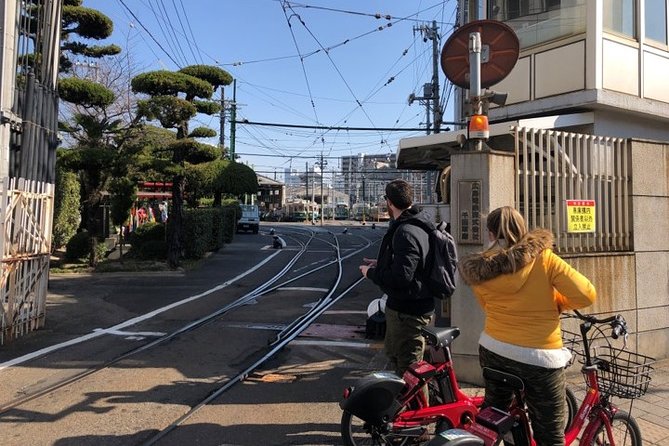
From the Atomic Bomb Dome, the route follows the Motoyasu River and crosses by the Peace Bridge. The riverside section brings a little breathing room after the Dome. You have about 15 minutes to see the water and hear how the area fits into Hiroshima’s present-day city life.
Higashisenda Park is about one kilometer from the center of the blast. Its trees were sent from countries around the world, and the guide explains the stories connected with the park. The 20-minute stop gives you time to walk among the trees rather than simply pause for a photograph.
This is where the tour’s focus on reconstruction becomes clear. You are not only looking at ruins or memorials. You are seeing public spaces, planted trees, riverside paths, and a functioning city that carries its past in plain view.
Other cycling tours in Hiroshima
The Red Cross Hospital and the Atomic Bomb Window Frame Monument
At the Hiroshima Red Cross Hospital, you see remnants of the former building in the form of the Atomic Bomb Window Frame Monument. The site lies about 1.5 kilometers from the blast center, and the guide uses the remaining structure to explain the bomb’s force.
You spend around 20 minutes here. It is a stark stop because a window frame and part of a hospital building make the destruction feel physical and immediate. The Atomic Bomb Dome is visually famous, but this quieter remnant can be just as instructive.
The route does not treat Hiroshima as a single dramatic landmark. Instead, it shows a series of distances from the blast center, each one telling you something about the scale of the destruction. That steady movement through the city is one of the tour’s strongest features.
Surviving trains, Miyuki Bridge, and the edge of destruction
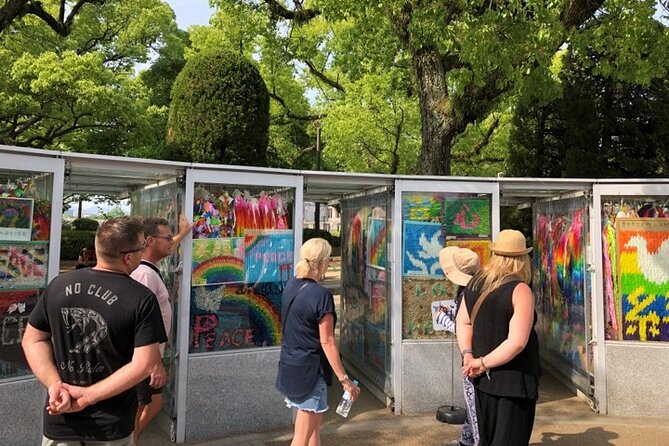
The next stop is Hiroshima Railway, about two to two and a half kilometers from the blast center. The guide explains that two trains survived the bombing and are still used today. You have only about 10 minutes here, but the detail is memorable because it connects wartime history with ordinary modern transport.
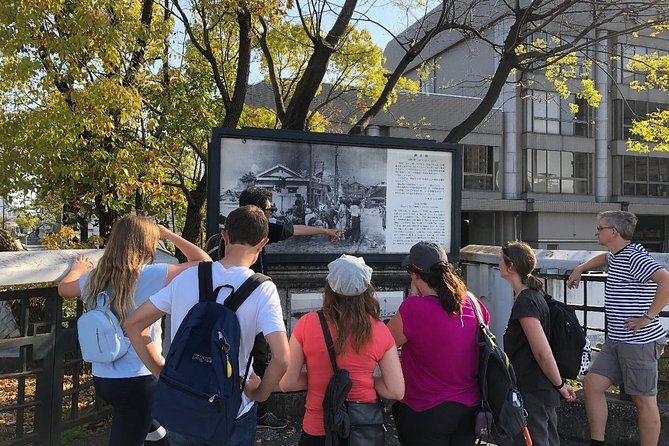
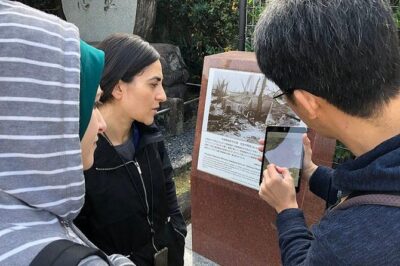
At Miyuki Bridge and the Kobayashi River, the tour reaches the point where the bomb’s effects ended. A photograph displayed here shows the difference between Hiroshima then and Hiroshima now. The stop lasts about 10 minutes, so listen closely and ask questions while the guide is explaining the image.
The route’s gradual movement outward is valuable. You begin with the central Peace Park, then follow the blast’s reach through surviving structures, transport, bridges, and residential areas. You gain a sense of scale that a single museum room cannot provide.
The surviving weeping willow and Peace Boulevard
The surviving weeping willow is presented as a highlight of the ride. The tree continued to grow despite expectations that natural growth would not return for many decades. It represents endurance, though the visit remains brief at about 10 minutes.
The final ride follows Peace Boulevard back toward the park. Along the way, you pass monuments and trees tied to Hiroshima’s past while seeing the city as it functions today. The contrast is the point: the route does not leave you with an image of Hiroshima frozen in 1945.
Return to the Peace Memorial Park at about 13:00. The final five minutes are mainly for ending the tour and saying goodbye. If you have not yet visited the museum, this is a sensible time to do it, though you should check its opening arrangements separately before planning your day around it.
The guides make the history personal
The guide is central to the experience. Several guides have been praised for clear English, strong storytelling, and personal family connections to Hiroshima.
Shin is frequently noted for sharing stories about his family and the long effects of the bombing. His mother was not yet born when the bomb fell, and he speaks about how August 6 shaped later generations. Moe has also shared family history, including the experiences of all four grandparents who lived through the bombing. Toma, Kana, and Thomas are also named as guides who combine local knowledge with an approachable manner.
That personal element can make the tour moving. It can also make it less predictable, since each guide will tell the story in a different voice. You should expect respectful, serious conversation rather than a light sightseeing ride, but the guides also bring warmth, humor, and practical help. Moe, for example, has offered restaurant suggestions at the end of the outing.
Is the $85.89 price good value?
At $85.89 per person, this is not the cheapest way to see Hiroshima. The value comes from the combination of an electric bicycle, a three-hour route, a local guide, a small group, included entrance fees, and bicycle accident insurance.
A self-guided visit to the Peace Park costs less, especially if you are happy to walk and read the signs. But it is harder to cover Hiroshima Castle, Gokoku Shrine, Higashisenda Park, the Red Cross Hospital, the railway site, and Miyuki Bridge in one morning without transport.
The tour is best value if you want context and efficient movement. It is less compelling if you prefer to spend a long time at each memorial or read every display at your own pace. I would pair it with independent time at the Peace Memorial Museum rather than treating the cycling tour as a replacement for the museum.
The small group also matters. With a maximum of 10 people, you can ask questions and hear the guide without the feel of a large coach outing. The current score is 5 out of 5 from 131 ratings, with 99 percent recommending it, but your own experience will still depend on weather, group pace, and the guide assigned that day.
Weather, timing, and practical limits
This is a fair-weather activity. If rain makes cycling unsafe, you may be offered a Rainy Day Limited Peace Route or a refund. The walking alternative visits the Peace Memorial Park, Atomic Bomb Dome, hypocenter, Former Bank of Japan, Fukuromachi Elementary School, and a main street before ending at the usual time.
You should wear comfortable clothes and shoes suitable for cycling and walking. Hiroshima Free Wi-Fi is available around the city, but there is no free Wi-Fi at the tour meeting point.
The tour is mixed, and the pace can be adjusted for children or people who are new to cycling. Adults need to be at least 145 centimeters tall for the adult electric bicycle. The activity is near public transport, and most people can participate, but anyone who cannot comfortably ride a bicycle should choose the walking option if available.
You can cancel for a full refund up to 24 hours before the start time. Cancellations or changes inside that window are not refunded or accepted. The operator can also cancel because of weather or safety concerns, in which case you are offered another date or a full refund.
Who should book the Peace Cycling Tour?
I would book this for a first visit to Hiroshima, especially if you want a clear introduction before exploring the museum on your own. It suits couples, families with suitable bicycle sizes, and people who want to see more than the best-known memorials.
It is also a good choice if you have only part of a day. The morning tour leaves the afternoon open, while the afternoon version lets you use the morning for another activity.
I would think twice if you dislike bicycles, need a slow museum-style visit, or expect every stop to receive equal time. Some locations last just 10 minutes, and the subject matter can be emotionally heavy.
For most visitors who are comfortable on an e-bike, the mix is unusually effective: personal stories, historic sites, quiet riverside riding, and a direct look at Hiroshima’s recovery. At the end, you understand not only what was destroyed, but also how the city chose to continue.
FAQ
Where does the Hiroshima Peace Cycling Tour begin?
The tour begins at the Hiroshima Peace Memorial Park Rest House in Naka Ward, Hiroshima.
Where does the tour finish?
The activity ends back at the Hiroshima Peace Memorial Park Rest House.
How long is the cycling tour?
The tour lasts about three hours. The morning outing is scheduled from 10:00 to 13:00, and the afternoon outing is scheduled from 14:00 to 17:00.
How many people can join the tour?
The shared tour has a maximum of 10 people.
Is the bicycle electric?
Yes. Adult electric bicycles are used for the tour. Children’s bicycles and electric bicycles with child seats are also available under the stated height and weight limits.
What height is required to use an adult bicycle?
The adult bicycle is available for people at least 145 centimeters tall. Children between 110 and 145 centimeters can use a children’s bicycle or an adult bicycle at the child rate, subject to availability.
What happens if it rains?
If rain prevents the cycling route from operating, you can choose the Rainy Day Limited Peace Route or a refund. The walking route includes the Peace Memorial Park, Atomic Bomb Dome, hypocenter, Former Bank of Japan, and Fukuromachi Elementary School.
Can I cancel for a full refund?
Yes. You must cancel at least 24 hours before the experience start time for a full refund. Cancellations made less than 24 hours before the start time are not refunded.
More Guided Tours in Hiroshima

More Cycling Tours in Hiroshima
More Hiroshima Cycling Tours in Hiroshima
More tours in Hiroshima we've reviewed
Hiroshima Cycling Tours, compared.
 ★ 5.0Hiroshima in a Nutshell: Morning Bike AdventureFrom $72
 ★ 5.0Hiroshima 2hr Peace Cycling Tour with Local GuideFrom $59
 ★ 4.8Hiroshima: Peace Cycling Tour with Local GuideFrom $522 - 3 hours
 ★ 5.0Hiroshima and Miyajima by Bike and BoatFrom $142
 ★ 4.9Hiroshima: Best of Hiroshima Guided Bike TourFrom $703h 30m
 ★ 5.0Hiroshima Country Cycling: Explore Rural Life 1 HR from CityFrom $85
 ★ 5.0Hiroshima: City and Miyajima Bike and Boat TourFrom $1387h 30m
 ★ 5.0Hiroshima Scenic Cycling Guided TourFrom $73
Browse the lists this tour appears in