
Reviewed · CYCLING TOURS
Tsuwano Cycling Tour with Local Guide
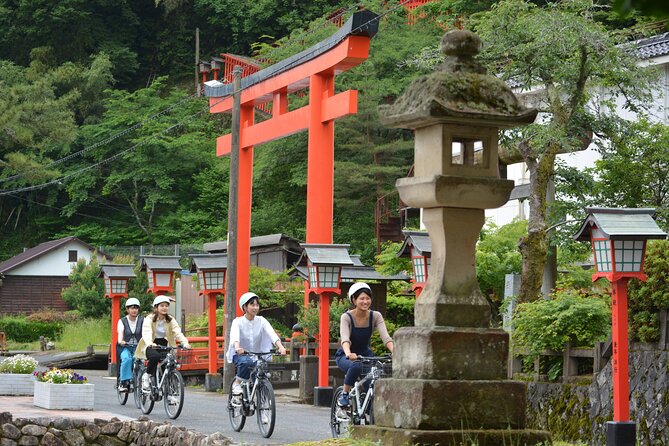
Tsuwano’s best feature is not a single monument. It is the way its old castle-town shape, shrines, water, and rural views still fit together. This three-hour electric-bike tour uses the Tsuwano Hyakkeizu, a set of 100 Edo-period scenes, to show you what has changed and what has not.
I like the small group size, capped at six, and the way the route reaches places you could easily miss on foot. I also like the electric bikes, which make the ride manageable even if you are unsure of your fitness.
The main consideration is weather. The tour requires good conditions, and the $99 price is worthwhile mainly if you want guiding and cultural context, not simply a bicycle ride.
In This Review
- Key points at a glance
- Why the Tsuwano Hyakkeizu makes this ride different
- Starting at Tonomachi Street
- Yasaka Shrine and the stories behind the paintings
- Narutaki Jinja and a quiet waterfall pause
- Washibara Hachiman Shrine and horseback archery
- Tsuwano Shrine and the former lords
- The giant cedar at the end
- How much riding should you expect?
- Is $99 a fair price?
- Who will enjoy this Tsuwano experience?
- Practical advice before you book
- Should you book the Tsuwano Cycling Tour?
- FAQ
- Where does the Tsuwano Cycling Tour begin?
- Where does the tour end?
- How long does the tour last?
- How many people can join?
- Is bicycle use included?
- Are food and snacks included?
- What happens if the weather is poor?
- Can I cancel for a full refund?
Key points at a glance
- Edo-era pictures guide the route: Compare today’s Tsuwano with scenes painted about 160 years ago.
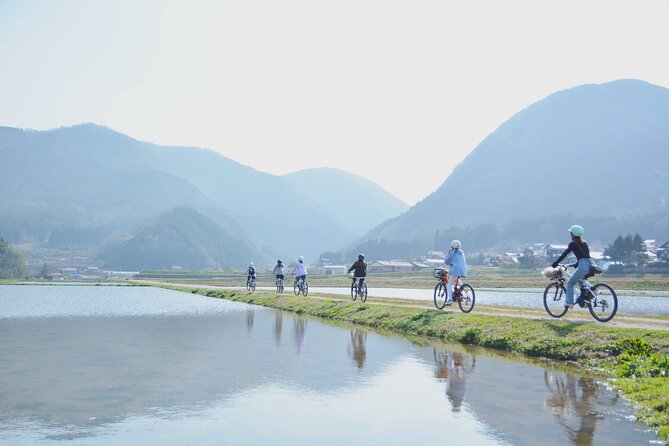
- Electric bikes keep the pace comfortable: You can focus on the town rather than worrying about hills or stamina.
- Six stops mix famous and quiet places: Tonomachi Street shares the route with a waterfall, shrines, and a giant cedar.
- Local guides add personality: Ale, Alessandro, and Yui are among the guides associated with the experience.
- The group never exceeds six people: That gives the tour a more personal feel and makes conversation easier.
- It returns to Tsuwano Station: The ride begins and ends near public transportation in front of Tsuwano Station.
Why the Tsuwano Hyakkeizu makes this ride different
Many town tours point out an old building, explain its age, and move on. This one has a better organizing idea: it asks you to look at Tsuwano through the eyes of artists from the late Edo period.
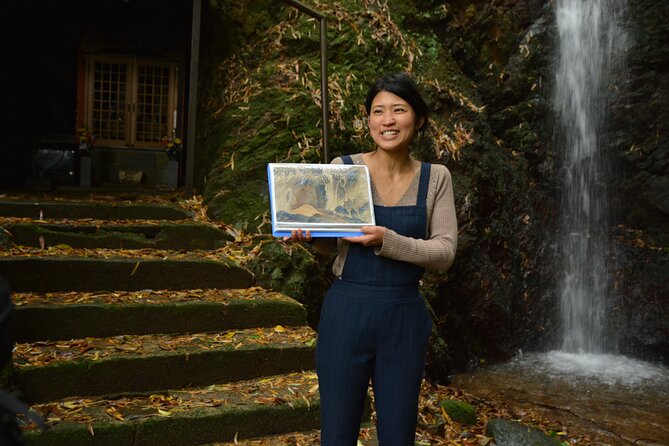
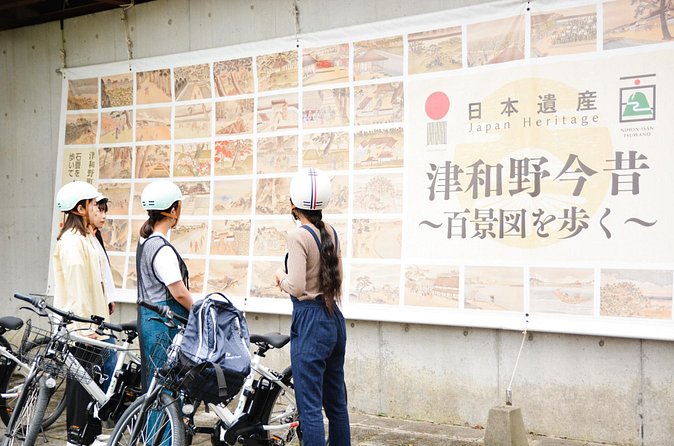
The Tsuwano Hyakkeizu contains 100 paintings of the Tsuwano domain from roughly 160 years ago. It has been recognized as a Japan Heritage site. During the ride, the guide uses these old images to compare the town then and now.
That changes the way you see ordinary places. A street is no longer just a street. A shrine is not only a place to take a photograph. You begin to notice the shape of the town, the position of the mountains, the routes used by the former lords, and the customs that still give Tsuwano its character.
I especially like this approach because it avoids a rushed checklist of sights. The old pictures give you something to look for. You are not only hearing facts. You are making comparisons with your own eyes.
Guides such as Ale and Alessandro have been praised for clear explanations, stories, and easy conversation. Yui is also associated with the tour and is described as friendly and careful with the pace. The exact guide may vary, but the experience is built around personal interpretation rather than a recorded audio script.
Starting at Tonomachi Street
The tour begins at Tsuwano Station, then moves toward Tonomachi Street, the town’s main road. You spend about 30 minutes cycling along this central stretch with the guide.
Tonomachi is a useful opening because it helps you get your bearings. It introduces Tsuwano as a small historic town rather than a collection of separate attractions. The guide can point out how the street fits into the former castle-town plan and connect what you see with the old scenes in the Hyakkeizu.
The free admission is less important here than the guiding. You could walk along Tonomachi on your own, but you would not necessarily know which details matter or how the street looked in the Edo period.
The ride is not designed as a speed contest. The route allows time to stop, listen, and ask questions. That is a good fit for you if you prefer understanding a place over covering maximum distance.
Yasaka Shrine and the stories behind the paintings
The next stop is Yasaka Shrine, where you spend another 30 minutes learning about the shrine and the less obvious stories connected to the Tsuwano Hyakkeizu.
This is where the tour’s central idea becomes more useful. A guide can show you an old painted scene, explain what it depicts, and then help you locate the same setting in the modern town. The pleasure comes from the contrast. Some features remain recognizable, while others have changed in ways that are hard to notice without a historical reference.
You should expect cultural explanation rather than a long formal ceremony. The stop focuses on the shrine’s past and the stories connected with Tsuwano’s old images.
The pace also helps here. Thirty minutes is enough to hear the main points without turning the visit into a lecture. If you enjoy small details, ask about the people, customs, or buildings shown in the paintings. The guides are encouraged to discuss the material rather than simply recite dates.
Narutaki Jinja and a quiet waterfall pause
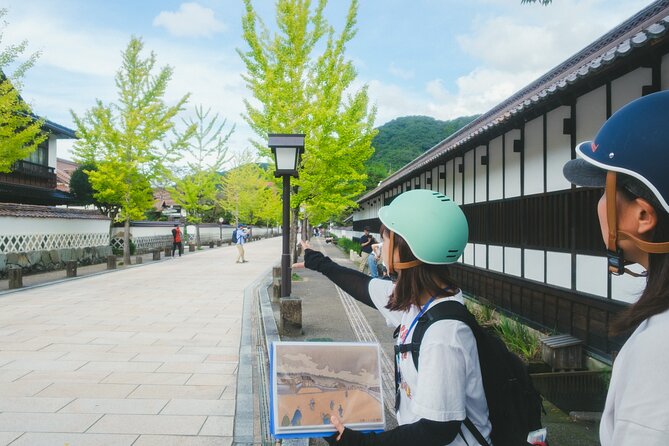
Narutaki Jinja brings a change of mood. The stop includes a hidden waterfall spot, more local history, and simple meditation practice. You have about 30 minutes here.
This is one of the tour’s more distinctive moments. Tsuwano is known for its old streets and shrines, but the waterfall gives you a quieter sense of the town. The sound and setting offer a pause from the road, while the guide explains how the place connects with Tsuwano’s past.
The meditation is described as simple, so you do not need special preparation or experience. Think of it as a short way to slow down and pay attention to the setting.
I like that this stop is not just another historical explanation. It adds a personal and reflective element. If you want only sightseeing at a fast pace, the pause may feel slow. If you appreciate calm places and time to absorb what you are seeing, it may become one of the most memorable parts of the ride.
Washibara Hachiman Shrine and horseback archery
The route continues to Washibara Hachiman Shrine, where the guide explains the large joyato, or stone lantern, and the baba, the horse track used for the Yabusame horseback archery ritual.
This stop gives you a clearer sense of the former domain’s ceremonial life. The stone lantern is a physical landmark, while the horse track connects the shrine with a traditional mounted archery practice. The explanation helps you understand why the site is more than a scenic stop.
The Yabusame connection is especially useful if you are interested in Japanese festivals and ritual traditions. The experience does not include a horseback archery performance, so you should not book it expecting a live show. Instead, you learn about the place where the ritual takes place and the stories attached to it.
A bicycle is practical here because it links the central town with sites that are not all clustered together. You see how the built-up streets give way to more open surroundings. That change is part of the experience.
Tsuwano Shrine and the former lords
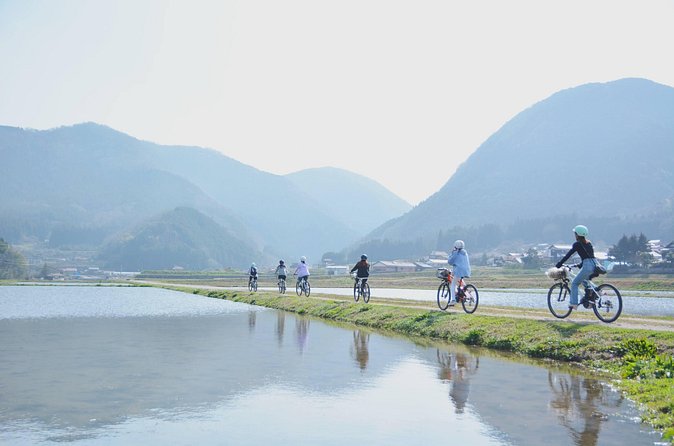
At Tsuwano Shrine, the focus shifts to the rural setting around the shrine and the stories of the former lords of the Tsuwano domain. Again, the visit lasts about 30 minutes.
This is a good point to pay attention to the view, not just the shrine itself. The surrounding fields and open countryside help explain Tsuwano’s position as a small domain town. The setting feels different from Tonomachi Street, and the bike makes that transition easy to appreciate.
The guide’s role matters here. Without context, the shrine and its surroundings could seem pleasant but vague. With the stories of the former lords and the old paintings in mind, you can better understand how power, religion, farming, and daily life fit together.
The route is not only about grand national history. It is about one local domain and the way its past remains visible in a small community. That narrower focus is a strength for anyone who wants a more personal view of Japan outside the largest cities.
The giant cedar at the end
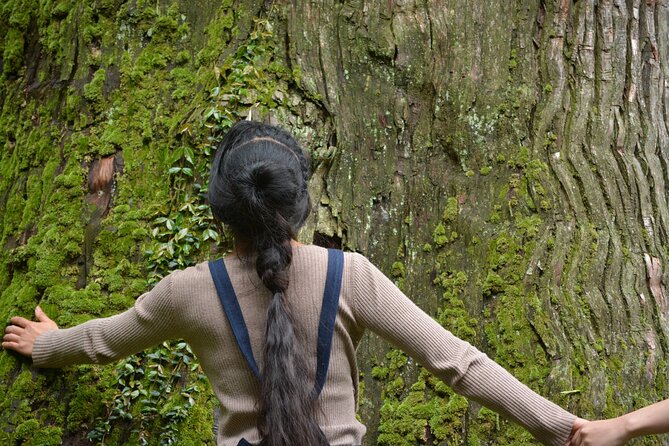
The final part of the route returns to Washibara Hachiman Shrine, this time to see a giant cedar said to have watched over Tsuwano for more than 1,000 years.
Ending with an old tree is a smart choice. After streets, paintings, shrines, and stories about lords, the cedar gives the tour a strong sense of time on a much larger scale. It is not an object made for one period of history. It has remained part of the place across many generations.
The exact order of the shrine visits may feel slightly repetitive on paper, since Washibara Hachiman appears in two parts of the route. In practice, the two themes are different: one centers on the stone lantern and Yabusame horse track, and the later visit centers on the cedar.
The tour ends back at the meeting point near Tsuwano Station. That makes it easy to continue your day by train or explore more of town on foot.
How much riding should you expect?
The activity lasts about three hours, with six stops of roughly 30 minutes each. The schedule suggests a relaxed sightseeing ride rather than a demanding cycling excursion.
The electric bicycle is an important part of the value. You still pedal, but the motor support can make the route less tiring. One useful point for anyone uncertain about fitness is that the guides are described as keeping a careful pace. You should still be comfortable riding a bicycle, but you do not need to approach this as an athletic event.
Because the group is limited to six people, the guide can adjust explanations and pace more easily than on a large bus tour. You can ask questions without holding up a crowd.
The activity is near public transportation, begins and ends at the station meeting point, and includes bicycle use and a guide. Snacks are not included, so plan to eat before or after the ride. No separate admission charge is listed for the stops.
Is $99 a fair price?
At $99, this is not the cheapest way to see Tsuwano. You can walk along Tonomachi Street and visit many public places without paying an admission fee.
The price makes more sense when you count what you are getting: an electric bicycle, three hours of local guiding, a small group, transport between central and rural sites, and a clear theme built around the Tsuwano Hyakkeizu. You are paying for access to interpretation and route planning, not for entry tickets.
I would consider it good value if you have limited time in Tsuwano or want the town’s history explained as you go. It is less appealing if you already know the Hyakkeizu, have your own bicycle, and prefer to explore at your own speed.
The tour also helps you avoid spending your visit on only the most obvious street. Its real value is the combination of well-known places with quieter stops such as Narutaki Jinja and the cedar.
Who will enjoy this Tsuwano experience?
I would choose this tour for you if you want a gentle outdoor activity with strong cultural content. It suits couples, solo visitors, families with older children, and anyone who prefers a small group to a large sightseeing bus.
It is also a good first activity in Tsuwano. The route gives you a working map of the town and introduces the main themes you can explore later: the old domain, shrine traditions, rural surroundings, and the Hyakkeizu.
You may want a different plan if cycling is uncomfortable for you, if you need a guaranteed indoor activity, or if your main goal is a long-distance ride. The tour requires good weather, and poor conditions can lead to a new date or a full refund.
The experience is mobile-ticketed, and confirmation comes at booking. You can cancel for a full refund up to 24 hours before the start time. Changes or cancellations inside that window are not accepted, and the local time cutoff applies.
Practical advice before you book
Meet at Tsuwano Eki mae, in front of Tsuwano Station, in Ushiroda, Tsuwano, Shimane. The tour returns to the same meeting point, which keeps the logistics simple.
Wear clothes that are comfortable for three hours of cycling and bring water. Snacks are not supplied, so use the station or town area before or after the activity if you need food.
Give yourself enough time to reach the station meeting point. The tour is capped at six participants, and a small group works best when everyone arrives ready to ride.
Try to keep the rest of your day flexible. The three-hour schedule is approximate, and you may want time afterward to revisit Tonomachi Street, eat, or see places not included in this route.
Should you book the Tsuwano Cycling Tour?
Book it if you want Tsuwano explained through its own old pictures, not just presented as a pretty small town. The comparison between the Edo-era Hyakkeizu and the present day is the tour’s strongest idea, while the electric bike, careful pace, and six-person limit make the outing comfortable.
I would especially recommend it as your first Tsuwano activity, or for a short visit when you want to reach shrines and rural sites without planning the route yourself. Skip it if you only want independent cycling, dislike fixed schedules, or cannot count on good weather.
For most visitors who want history, local stories, scenery, and a manageable ride in one package, $99 is a reasonable price for three focused hours.
FAQ
Where does the Tsuwano Cycling Tour begin?
The tour begins at Tsuwano Eki mae, in front of Tsuwano Station in Ushiroda, Tsuwano, Shimane Prefecture.
Where does the tour end?
The activity ends back at the meeting point near Tsuwano Station.
How long does the tour last?
The tour lasts approximately three hours.
How many people can join?
The tour has a maximum of six participants.
Is bicycle use included?
Yes. Use of the bicycle and a guide are included in the tour price.
Are food and snacks included?
No. Snacks are not included.
What happens if the weather is poor?
The tour requires good weather. If it is canceled because of poor conditions, you will be offered a different date or a full refund.
Can I cancel for a full refund?
Yes. You can cancel at least 24 hours before the experience start time for a full refund. Cancellations or changes made less than 24 hours before the start time are not accepted for a refund.
Cycling Tours, compared.
 ★ 5.0Bike Tour Exploring North Kyoto plus LunchFrom $106
 ★ 5.0Tokyo Great Cycling TourFrom $99
 ★ 5.0Tokyo Top Highlights 3h Guided E-bike TourFrom $63
 ★ 5.03h Tokyo E-Bike Tour: Hidden Gems, and Local Life with guideFrom $63
 ★ 5.0Arashiyama Bamboo Forest & Hidden Gems Bike Tour (Early Bird)From $106
 ★ 5.0Hiroshima in a Nutshell: Morning Bike AdventureFrom $72
 ★ 5.05 Top Highlights of Kyoto Full Day Bike Tour (E-bike option)From $172
 ★ 4.83-Hour Bike or E-Bike City Highlights TourFrom $453 hours