
Reviewed · E-BIKE TOURS
Akagi Great countryside e-bike tour
The best part of the Akagi Great countryside e-bike tour is its close look at everyday Gunma, not just postcard scenery. You pedal from Maebashi through town streets, rice fields, shrine grounds, ancient burial mounds, and working food businesses before finishing in another part of the prefecture. I like the mix of ordinary local life and major historic sites, especially the chance to walk inside an old tomb. I also like the small group size, capped at six, which should make it easier to ask questions and keep a comfortable pace.
The main consideration is the physical and logistical side. You need to be at least 150 centimeters tall, have moderate fitness, and reach Maebashi Station on time with the correct train. One booking mistake sent a participant toward Utsunomiya instead of Takasaki, costing about 45 minutes before the route back to Maebashi, so check your rail plan carefully.
In This Review
- Key points to know before booking
- Why this e-bike ride feels different from a standard sightseeing tour
- Starting in Maebashi with coffee and local snacks
- Santai Shrine and living local customs
- Omuro Park and tombs you can enter
- Lunch at Ota Shokudo
- Oka Naosaburo Shoten, a working soy sauce brewery
- The route from Maebashi Station to Akagi Station
- Is $113.37 a fair price?
- Who will enjoy this ride most?
- Should you book the Akagi Great countryside e-bike tour?
- FAQ
- Where does the Akagi Great countryside e-bike tour start?
- Where does the tour finish?
- How long does the tour last?
- How much does the tour cost?
- How tall must I be to join?
- How fit do I need to be?
- How many people can join the tour?
- What happens if the weather is poor or the tour does not reach its minimum number?
Key points to know before booking
- Start at Maebashi Station and finish at Akagi Station: This is a point-to-point ride, not a loop.
- See ancient tombs at Omuro Park: You can climb onto the mounds and enter one of the tombs.
- Taste Gunma through local food: Lunch is katsu served over curry ramen or rice at Ota Shokudo.
- Visit a working soy sauce brewery: Oka Naosaburo Shoten has made soy sauce for 230 years.
- Ride with a maximum of six people: The small group suits anyone who wants a more personal outing.
- Plan for a six-hour activity: You need moderate fitness and a minimum height of 150 centimeters.
Why this e-bike ride feels different from a standard sightseeing tour
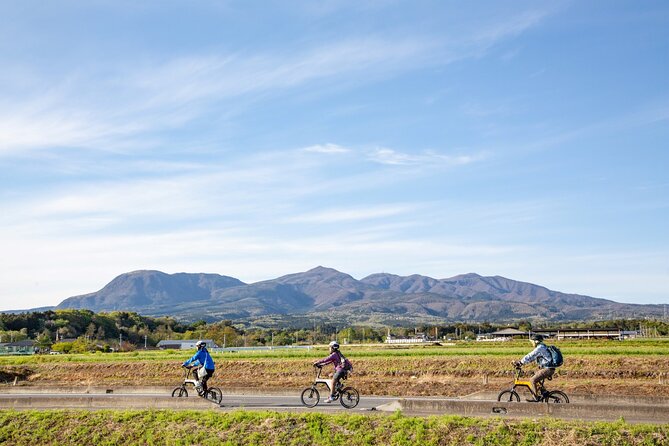
Gunma is easy to overlook if your Japan trip stays on the Tokyo, Kyoto, and Osaka circuit. That is exactly why this outing can be worthwhile. From the saddle of an e-bike, you get a slower view of the area around Mt. Akagi, with time to notice rice fields, local roads, community shrines, and businesses that still make food in traditional ways.
The route also has a useful rhythm. You begin in Maebashi, where you get coffee and snacks, then move toward religious and archaeological sites. After lunch, the tour turns to food production at a soy sauce brewery. You are not simply riding past rural Japan. You stop and get an explanation of why these places matter.
I especially like the contrast between the stops. Santai Shrine is still part of local life, with couples hoping for children and young families visiting with small children. Omuro Park takes you much farther back, to tombs from the 5th and 6th centuries. The soy sauce brewery brings you into a working business with a 230-year history. Together, the stops show Japan as a place where old customs, ancient monuments, and active family businesses share the same day.
The e-bike matters, too. The supplied details do not describe the exact route length or hill difficulty, so you should not assume this will feel effortless. Still, electric assistance makes a six-hour ride more approachable than a standard bicycle tour. You will need moderate fitness, but the format is less demanding than riding a regular bike over the same distance.
Starting in Maebashi with coffee and local snacks
Your guide meets you at Maebashi Station, at 2 Chome-29 Omotecho, with the e-bikes ready. That is a convenient start if you are staying in the Kanto region and can reach Maebashi by train. It also means you should build in enough time to find the station meeting point rather than arriving at the last minute.
The first 45 minutes take you around Maebashi’s urban area. This opening section gives you time to get used to the bike and to see the city before heading into more open country. Coffee and snacks provide a gentle introduction to the local food scene, though the available details do not name the café or specify exactly what is served.
For me, this is a smart way to begin. A guided ride can feel rushed if you are handed a bike and immediately sent into the countryside. Starting in town gives you a chance to settle in, learn how the e-bike feels, and ask early questions. It also shows that the experience is not built only around famous sights. The city itself is part of the story.
You should keep your expectations realistic. This is a short urban introduction, not a full Maebashi city tour. If you want major museums or a long architectural walk, this outing is not designed for that. Its purpose is to connect Maebashi with the rural and cultural stops that follow.
Santai Shrine and living local customs
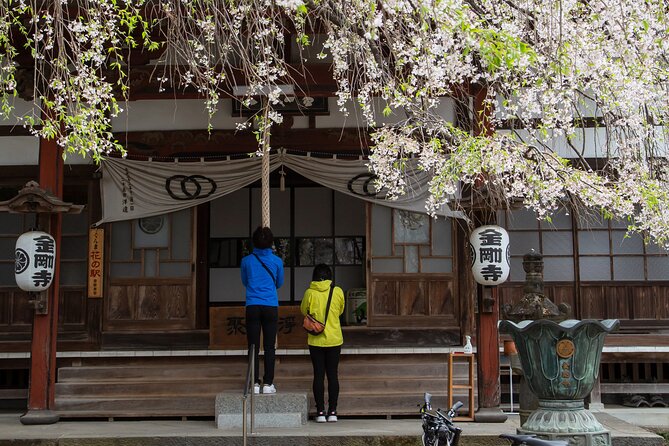
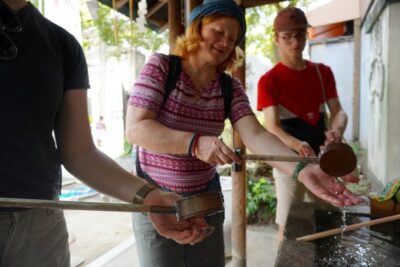
The next stop is Santai Shrine, where you spend about 30 minutes. Its main deity is associated with safe childbirth, so the shrine draws young couples hoping to have children and families with small children.
This gives the stop a human focus. You are not looking at a shrine only as an old building or a photo opportunity. You are seeing a place that still has a practical role in the community. The visit can help you understand how Shinto sites remain connected to family hopes and important stages of life.
Thirty minutes is enough for a focused visit, though not for a long, unhurried exploration. Your guide is expected to explain the site and its cultural setting, but the supplied information does not provide a guide name or a detailed account of any ceremony. Treat this as a meaningful stop along the ride rather than a stand-alone shrine pilgrimage.
The route’s variety is its strength here. After the city, the shrine changes the pace and gives you a quiet cultural pause. You can also expect some walking during the stop, so comfortable shoes and clothing suited to both cycling and short visits are sensible.
Omuro Park and tombs you can enter
Omuro Park contains several large tombs dating from the 5th and 6th centuries. They remain in their original forms, and you can walk up to the top of the mounds. Most unusual, you can enter one of the tombs.
That access makes this more than a quick stop for photographs. Ancient burial mounds can be hard to understand when you view them only from a distance. Walking up onto one and entering a tomb gives you a physical sense of the site. You can see the scale and shape directly, rather than relying on a museum display or a sign.
The visit lasts about 30 minutes. That should be enough for an introduction and a short walk, but it is not an extended archaeological visit. The details provided do not identify the exact tomb you enter or describe the walking surface, so anyone with mobility concerns should ask the operator for current conditions before booking.
I like the way this stop adds depth to the day. The shrine reflects present-day religious life, while Omuro Park connects you with powerful local figures from many centuries ago. The playful instruction to thank the ancient kings for their generosity hints at the relaxed tone of the experience, but the site itself gives the ride serious historical weight.
Lunch at Ota Shokudo
After the morning ride, you stop for one hour at Ota Shokudo, described as a cozy Japanese country restaurant. The featured meal is deep-fried Japanese katsu served on either curry ramen or rice.
This is exactly the kind of meal that suits a cycling day. Katsu offers a substantial portion, and the choice between curry ramen and rice lets you pick the format you prefer. Curry ramen gives you a noodle-based dish, while rice is the more familiar pairing for a cutlet.
The information provided does not clearly state whether lunch is included in the tour price. I would confirm that before booking, along with any drink arrangements. The restaurant stop itself is part of the planned experience, but a listed meal does not automatically tell you how payment is handled.
One hour should allow time to eat without turning lunch into a long break. If you have dietary restrictions, check ahead. No vegetarian, allergy, or substitution details are provided. The meal is a fixed local-style stop, so it is best suited to someone happy to try a hearty Japanese country lunch rather than someone seeking a broad menu.
Oka Naosaburo Shoten, a working soy sauce brewery
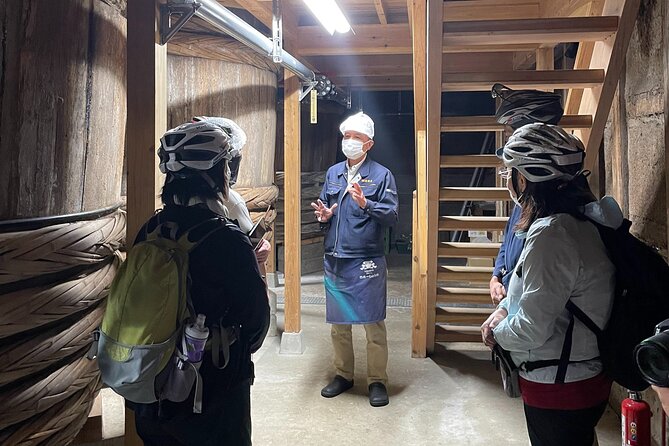
The final major stop is Oka Naosaburo Shoten, written in Japanese as 株式会社岡直三郎商店醤油蔵. This is an active soy sauce brewery with 230 years of history, operating inside a 100-year-old soy sauce cellar.
This may be the most distinctive stop on the tour. You are not visiting a decorative reconstruction. Brewery staff explain how soy sauce is made inside the cellar and answer questions. That working setting gives the food a clear sense of place and helps you see soy sauce as a craft with an ongoing role in Japanese cooking.
The stop lasts about 30 minutes, so the explanation will be an introduction rather than a full production course. Still, it is a good use of the final part of the day. You have already eaten a local dish, and now you can learn about one of the ingredients that shapes Japanese food.
The brewery also gives the tour a strong finish. Instead of ending with a viewpoint or a souvenir shop, the ride ends with a real local enterprise. You leave with a better understanding of how food is produced, not just how it appears on your plate.
The route from Maebashi Station to Akagi Station
This is a point-to-point trip. You start at Maebashi Station in Maebashi and end at Akagi Station in Midori City. That structure can be useful if you want to keep exploring after the ride, but it requires more planning than a tour that returns to its starting point.
At the end, you can continue around another part of Gunma, take a direct train to Tokyo, or use a local train back to Maebashi. The information supplied does not give the exact train schedules or journey times, so check them before the tour, especially if you have a fixed evening plan.
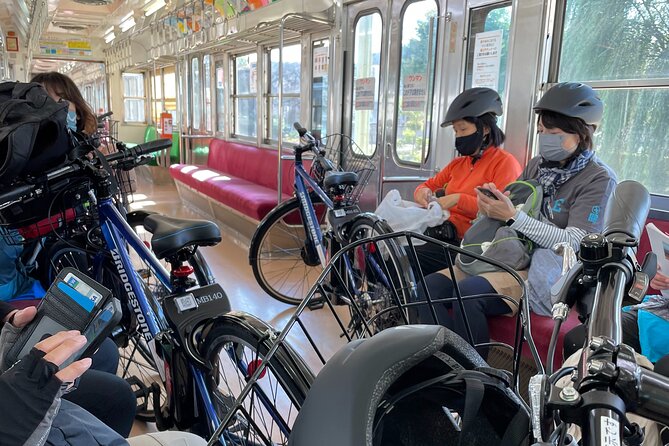
Take particular care with the approach to Maebashi. One participant boarded the wrong bullet train, heading to Utsunomiya instead of Takasaki, then needed around 45 minutes to get back on course. Maebashi Station was another 15 minutes from there. The practical lesson is simple: confirm the correct destination and allow a generous buffer.
A mobile ticket makes access convenient, and the tour is near public transportation. Group discounts may help if you are booking with friends or family, but compare the final price for your party rather than assuming the discount will apply in every case.
Is $113.37 a fair price?
At $113.37 per person, this is not a cheap way to rent a bicycle for a few hours. You are paying for a guided six-hour outing that combines transport by e-bike, local interpretation, food stops, a shrine, ancient tombs, and access to a historic soy sauce brewery.
The value depends on what you want from Gunma. If you only need a bicycle and prefer to choose your own route, the price may feel high. If you want someone to connect the places, handle the route, and explain local customs and food production, the price is easier to justify.
The maximum of six people improves the value for anyone who dislikes large groups. A small group gives you a better chance to ask questions and should make it easier to keep the ride personal. It also limits the social scale of the experience, so you should not book it expecting the energy of a large group excursion.
Admissions are listed as free at the stops, but that does not clarify exactly what the tour price covers. Confirm the treatment of lunch, coffee, snacks, and any other personal costs before you pay. This is especially important because the food stops are central to the experience.
Who will enjoy this ride most?
I would recommend this tour to you if you want to see a quieter side of Japan and are comfortable spending much of a day on a bicycle. It suits people who enjoy local food, religious sites, archaeology, and small-scale cultural visits more than those looking for a fast list of headline attractions.
It is also a good choice if you have already seen the main sights in Tokyo and want a different day in the Kanto area. The route gives you a reason to travel into Gunma, and the end at Akagi Station lets you continue onward instead of forcing you back to the starting point.
The tour is less suitable if you are under 150 centimeters tall, since child-sized bikes are not available. It is also not the right pick if you have low fitness or do not want a six-hour activity with cycling and walking.
Weather matters. The experience requires good conditions, and poor weather can lead to a new date or a full refund. You can cancel without penalty up to 24 hours before the start time, but cancellations or changes made later are not accepted. The tour also requires a minimum number of participants, so a low booking count can result in a new date, another experience, or a full refund.
Should you book the Akagi Great countryside e-bike tour?
Book it if you want a small-group view of rural Gunma that goes beyond scenery. The ancient tomb you can enter, the family-focused shrine, the katsu lunch, and the working soy sauce brewery create a varied day with genuine local texture.
Skip it if you want a short city activity, need a child-sized bike, or prefer to control every stop yourself. Also check your train route carefully and confirm what food costs are included.
For the right visitor, this is a strong value at $113.37 because it turns a day of cycling into a connected story about community, faith, archaeology, and food. The five-star rating and praise for exceeding expectations fit the experience’s main strength: it offers much more than a scenic bike ride.
FAQ
Where does the Akagi Great countryside e-bike tour start?
The tour starts at Maebashi Station, located at 2 Chome-29 Omotecho, Maebashi, Gunma 371-0024, Japan.
Where does the tour finish?
The tour ends at Akagi Station in Omama, Midori City, Gunma. From there, you can continue exploring, take a direct train to Tokyo, or use a local train back to Maebashi.
How long does the tour last?
The activity lasts approximately six hours.
How much does the tour cost?
The listed price is $113.37 per person. Group discounts are available. The supplied details do not clarify which food and drink costs are included, so confirm this before booking.
How tall must I be to join?
Participants must be at least 150 centimeters, or about 5 feet, tall. Child-sized bikes are not available.
How fit do I need to be?
You should have a moderate level of physical fitness. The experience includes e-bike riding and walking at several stops.
How many people can join the tour?
The tour has a maximum of six participants.
What happens if the weather is poor or the tour does not reach its minimum number?
If poor weather causes cancellation, you can choose another date or receive a full refund. If the minimum number of participants is not met, you can be offered another date or experience, or receive a full refund.
E-Bike Tours, compared.
 ★ 5.0Tokyo Top Highlights 3h Guided E-bike TourFrom $63
 ★ 5.03h Tokyo E-Bike Tour: Hidden Gems, and Local Life with guideFrom $63
 ★ 5.05 Top Highlights of Kyoto Full Day Bike Tour (E-bike option)From $172
 ★ 4.83-Hour Bike or E-Bike City Highlights TourFrom $453 hours
 ★ 5.0E-Bike Tours of the highlights of Kyoto!!!From $109
 ★ 4.83-hour Guided E-Bike Tour of the City’s Hidden GemsFrom $65
 ★ 5.0Osaka E-Bike Tour with a Local GuideFrom $59
 ★ 5.03-Hour Bike/E-Bike Tour of the City’s HighlightsFrom $63
Browse the lists this tour appears in